Paso del Fuego of San Pedro Manrique
On Midsummer's Eve, in a village in the Soria highlands, locals walk barefoot across a carpet of glowing oak embers, often with someone on their shoulders. The next day belongs to the Móndidas.
The days that matter
-
Wed 23 Jun around 21:00
The oak bonfire is lit
The bonfire beside the hermitage of the Virgen de la Peña is lit and left to burn down to embers.
-
Wed 23 Jun around 23:30
The carpet of embers
The embers are raked flat with long poles while the young men dance around the fire.
-
Midnight 23–24 Jun 00:00
Paso del Fuego
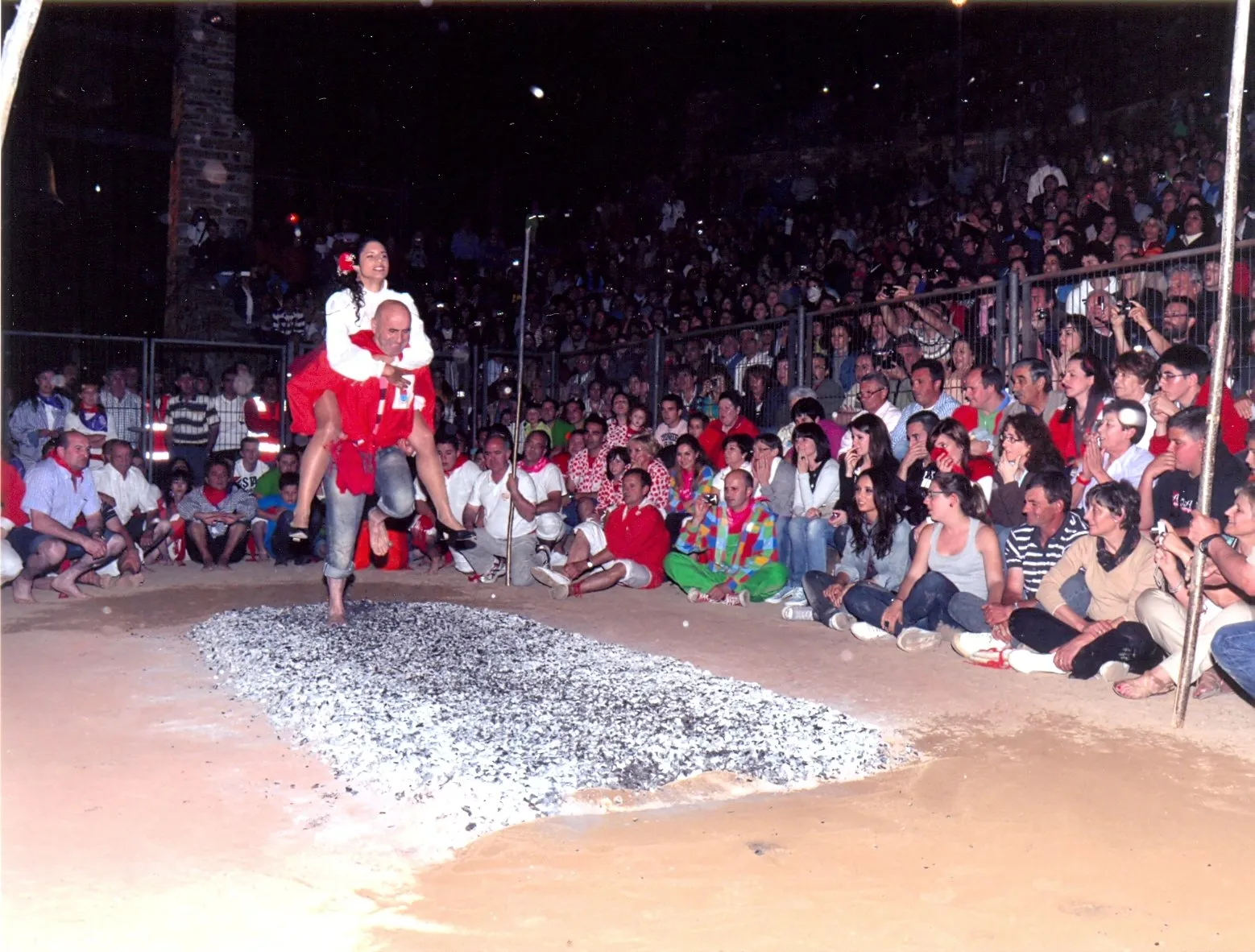
The Móndidas enter, then the pasadores cross the embers barefoot, many carrying someone on their shoulders.
-
Thu 24 Jun
Fiesta de las Móndidas
The three Móndidas, in white with their cestaños, walk in procession and offer the first arbujuelo to the priest.
What Paso del Fuego of San Pedro Manrique is like
- Fire
- Night
- Procession
- Noise
- Music, dancing and cheering around the fire
- Fire
- A whole bonfire turned into a carpet of embers, walked on barefoot
- Crowds
- Thousands pack a small enclosure in a village
- With kids
- Fascinating, but it runs past midnight; the Móndidas day is easier
Highlights
Night of Wednesday 23 June 2027: barefoot crossing of the embers at midnight
Pasadores in red sashes, many carrying a person on their shoulders
The three Móndidas, with their bread-and-saffron head baskets, on 24 June
A packed grandstand beside the hermitage of the Virgen de la Peña
Fiesta de Interés Turístico Nacional
Paso del Fuego 2027: dates
The Paso del Fuego always takes place on the night of 23 June, the eve of San Juan, and the Móndidas festivities follow on 24 June. In 2027 that means the night of Wednesday 23 June and Thursday 24 June. Spain's official tourism portal lists the same dates for 2027.
What happens
As Midsummer night falls, the stands of the enclosure beside the hermitage of the Virgen de la Peña, above San Pedro Manrique, fill with locals and visitors. A large bonfire of oak wood is lit in the evening and left to burn down. Later it is raked and smoothed with long poles into a carpet of embers, and at midnight the crossing begins.
The pasadores, local men and, today, women too, wear a red sash. One by one they walk barefoot across the embers, alone or carrying someone on their shoulders. Local tradition holds that only people from San Pedro Manrique can cross without being burnt. Just before the ritual, the three Móndidas, young unmarried women of the village, make their entrance.
Embers, measured
The fire-walk has drawn scientists as well as spectators. A team based at Aarhus University in Denmark recorded heart rates during the ritual and published its findings in the journal PNAS in 2011. The researchers describe a bed of embers about seven metres long, made from more than two tonnes of oak that had burned for four hours, with a surface temperature of 677 °C. Each crossing took four to five seconds, most walkers carried a friend or relative, and the heart rhythms of the walkers and of their related spectators rose and fell together, while those of visitors with no tie to them did not.
The Móndidas
On 24 June the Móndidas lead the celebrations. Dressed in white, each wears a cestaño, a basket on the head decorated with bread flowers and long sticks of flour and saffron called arbujuelos. They walk in procession, and the main Móndida offers the first arbujuelo to the priest. Some see them as an echo of the priestesses of the Celtiberian tribes; the regional tourism board describes them as symbols of the fire goddesses of Celtic mythology. The three are drawn by lot among the village's unmarried young women in early May.
A week of fiesta
The fire and the Móndidas sit inside a longer run of fiestas. In 2026 the programme ran from 22 to 29 June. The 24th opened with a diana and the caballada, a horse race, before the mass with the Móndidas' offering, the raising of the mayo, a tall pole, and the reciting of verses. The following days brought verbenas, traditional games, shared meals and processions between hermitages, and the cycle closed on 29 June, the feast of San Pedro.
Status
The Paso del Fuego is a Fiesta de Interés Turístico Nacional, listed by Spain's Secretary of State for Tourism in 1980. Its origin is described as immemorial, possibly Celtiberian, and it is linked to the purifying power of fire on the shortest night of the year.
History & Origins
Nobody knows when the people of San Pedro Manrique first walked over fire. Sources describe the rite as immemorial and link it to pre-Roman, possibly Celtiberian, fire cults of the summer solstice, later absorbed into the feast of Saint John the Baptist and the devotion to the Virgen de la Peña, in front of whose hermitage it takes place. Another theory connects the Móndidas with the legend of the Tribute of the Hundred Maidens, which Christian kingdoms were said to have paid to the Moors.
For generations the pasadores were young men of the village; today women cross too. The rite was included in the national list of festivals of tourist interest published in the BOE in February 1980, and the setting is also protected as a site of ethnographic interest. In the 21st century the ritual has also become a subject of research: in 2011 a team from Aarhus University published a study of the heart rates of fire-walkers and spectators recorded at San Pedro Manrique.
What to Expect
According to Spain's tourism portal, the oak bonfire is lit at around nine in the evening. At about half past eleven the embers are spread into a carpet with long poles called hoguneros, the young men dance around the fire, and at midnight the crossing begins. The pasadores tread firmly, many with someone on their back; the extra weight and a clean bed of embers, free of ash and hard objects, are part of the local explanation for why they do not get burnt.
The enclosure is small and the stands fill well before midnight. More than 2,400 people attended in 2025, a lot for a village of this size. Next day the mood changes: the Móndidas procession in white is a quieter, more festive moment.
How to Get There
San Pedro Manrique is in the Tierras Altas, the highlands in the north-east of Soria province. The practical way to get there is by car: from Soria, take the N-111 north to Garray and continue through the Tierras Altas; the last stretch is on local roads.
The nearest railway station is in Soria, the provincial capital. Public transport to the village is very limited, so plan to drive or share a car, and remember that the crossing ends well after midnight.
Tips & Advice
Arrive early. The stands around the fire pit fill up long before midnight, and the best views go to those who wait.
Sleep nearby or in Soria. Rooms in the Tierras Altas are few, so book early or stay in Soria and drive back after the crossing.
Bring a layer. Even in June, nights in the Soria highlands can be cool once you move away from the fire.
Stay for the 24th. The Móndidas procession is the other half of the fiesta and is easy to enjoy without the midnight crowds.
Watch, don't cross. The crossing is for the village's own pasadores.
Encierros de Cuéllar
Cuéllar, Castilla y LeónFive mornings of bull runs in a walled Segovian town, where riders bring the herd across open country and through the pinewoods before the animals charge into the streets.
Semana Santa de Valladolid
Valladolid, Castilla y LeónValladolid's Semana Santa is the antithesis of Andalusia's exuberant celebrations. Here, silence and sobriety reign. The star of the show is the extraordinary collection of polychrome sculptures by Gregorio Fernández, 17th-century masterpieces of such realism they seem to breathe.
Medieval Market of Ávila
Ávila, Castilla y LeónThe Mercado Medieval de Ávila is one of the largest and most spectacular medieval markets in Europe. Every September, the stunning UNESCO World Heritage walled city of Ávila transforms into a living medieval town with over 200 stalls, jousting tournaments, troubadours, falconry displays and theatrical performances. Set against the backdrop of Ávila's perfectly preserved 11th-century walls — the finest in Spain — it's a magical step back in time.
Semana Santa de Salamanca
Salamanca, Castilla y LeónHooded brotherhoods carry their pasos past golden sandstone cathedrals, a Roman bridge and the oldest university in Spain in a Holy Week of International Tourist Interest.