Semana Santa de Salamanca
Hooded brotherhoods carry their pasos past golden sandstone cathedrals, a Roman bridge and the oldest university in Spain in a Holy Week of International Tourist Interest.
The days that matter
-
Fri 19 Mar evening
Vía Matris
The Vera Cruz brotherhood's procession on the Friday of Sorrows opens the week.
-
Sun 21 Mar morning
La Borriquilla
Palm Sunday procession of Jesus entering Jerusalem, organised by the Hermandad de Jesús Amigo de los Niños.
-
Tue 23 Mar night
Hermandad Universitaria
Promise of silence in the Patio de Escuelas, with doctors in academic dress beside the paso.
-
Thu 25 Mar night
Amor y Paz over the Roman bridge
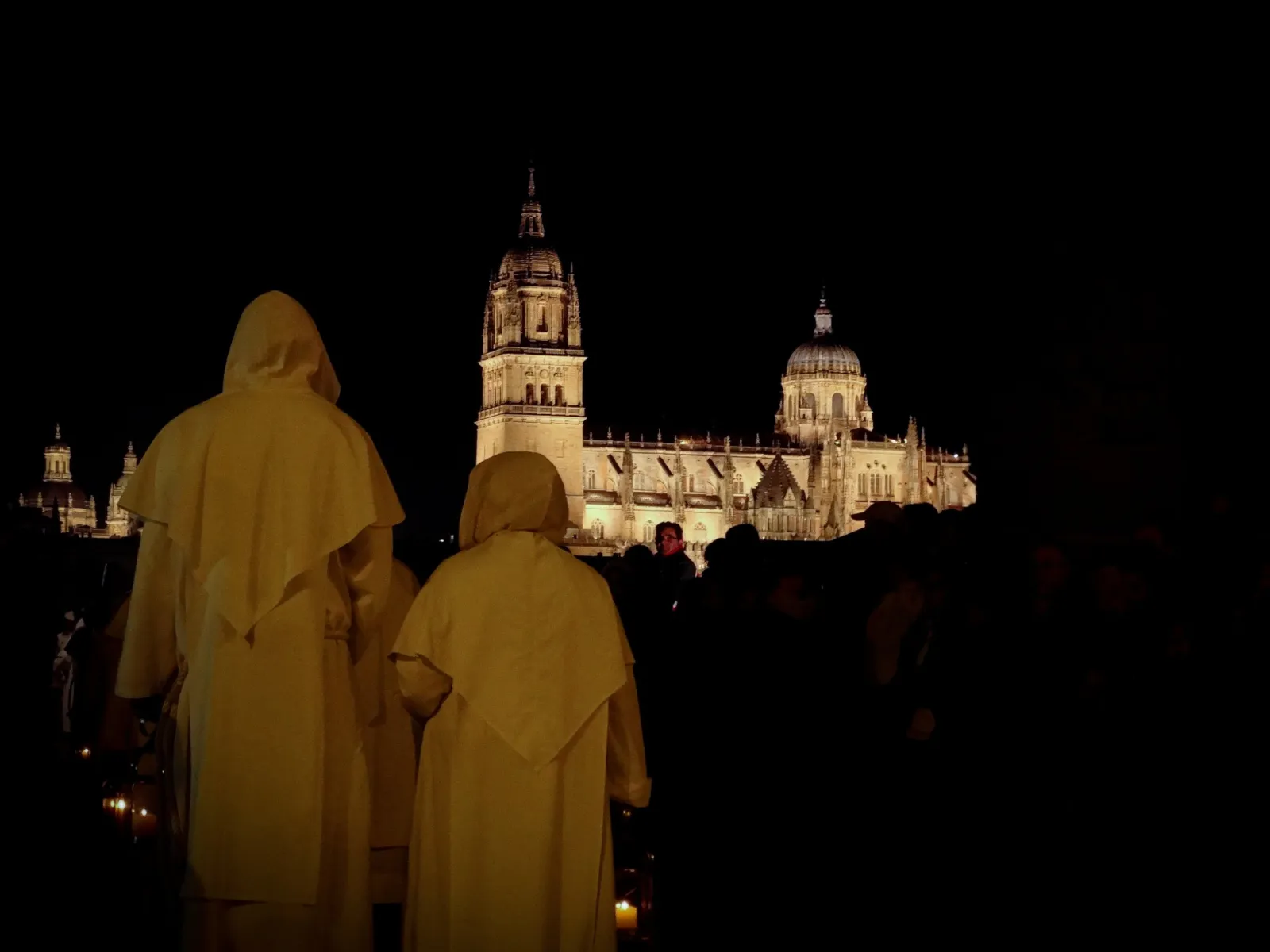
The Hermandad del Amor y de la Paz crosses the Tormes with the cathedrals lit up behind it.
-
Fri 26 Mar early hours
Hermandad Dominicana
A procession with an Andalusian feel, with charros in mourning dress walking before the Virgin.
-
Fri 26 Mar afternoon
Descendimiento and Holy Burial
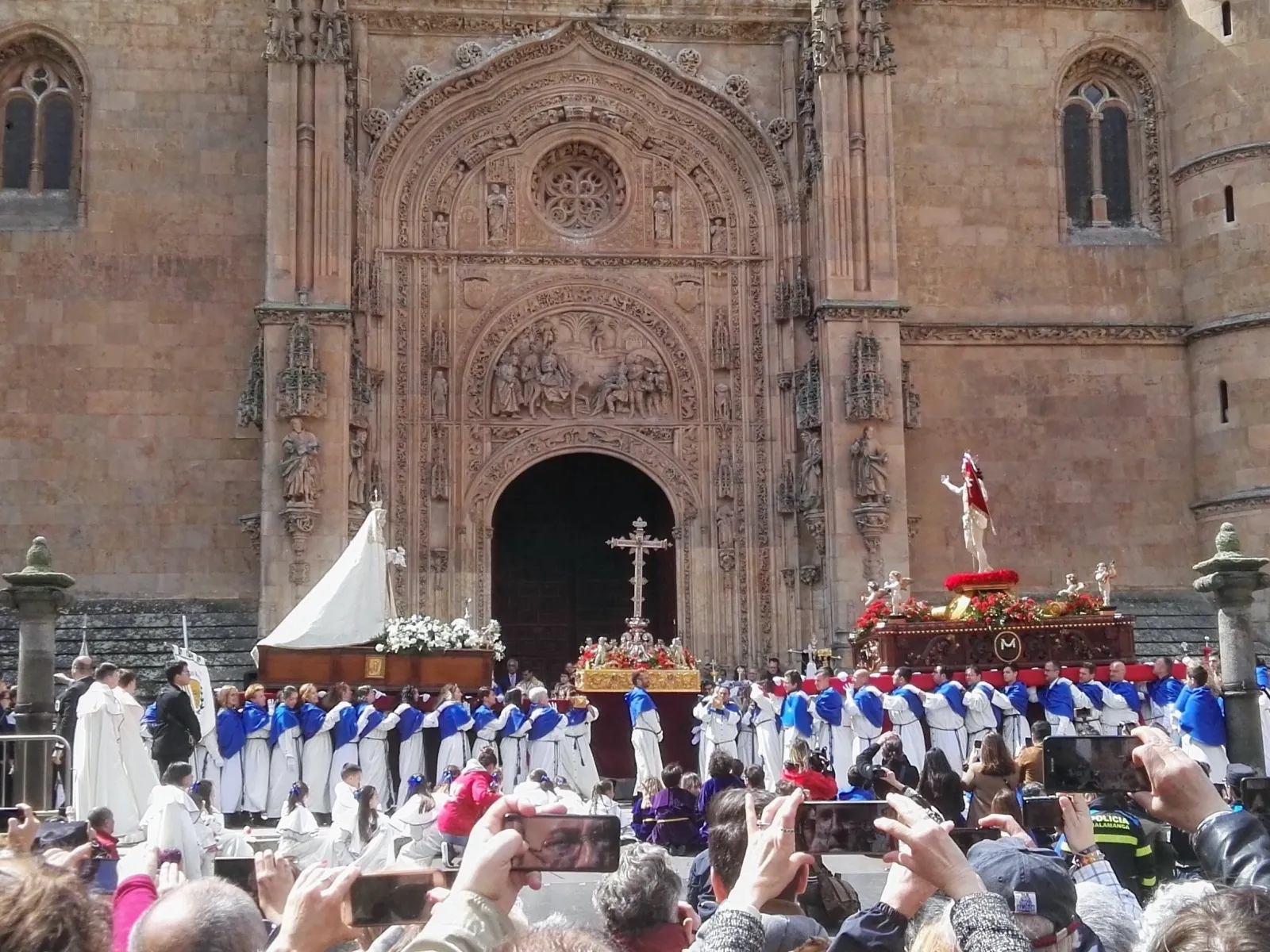
Two Vera Cruz members take Christ down from the cross before the Holy Burial procession, as since 1615.
-
Sun 28 Mar morning
El Encuentro
The meeting of the risen Christ and his Mother, held since 1616, with charros dancing.
What Semana Santa de Salamanca is like
- Procession
- Night
- Free
- Noise
- Mostly silent processions with drums and bands
- Crowds
- Busy old town, especially near the cathedrals on Thursday and Friday
- With kids
- Daytime processions and Easter Sunday suit children; late nights less so
Highlights
19–28 March 2027, from the Friday of Sorrows to Easter Sunday
Hermandad Universitaria's promise of silence in the Patio de Escuelas on Holy Tuesday
Maundy Thursday night procession of the Hermandad del Amor y de la Paz over the Roman bridge
Good Friday's Descendimiento and Holy Burial, first held in 1615
Easter Sunday Encuentro, with charros dancing before the risen Christ
Holy Week 2027 in Salamanca: dates
Salamanca's Holy Week was declared a Fiesta of International Tourist Interest in 2003. Processions begin on the Friday of Sorrows (Viernes de Dolores) and end on Easter Sunday, so in 2027 the week runs from Friday 19 to Sunday 28 March, with Palm Sunday on 21 March and Good Friday on 26 March. The opening act is the Vera Cruz brotherhood's Vía Matris procession on the Friday of Sorrows, which closes its novena to the Virgin of Sorrows. The brotherhoods publish exact times and routes in the weeks before.
A Holy Week with a stage set
Eighteen brotherhoods, confraternities and congregations, grouped in the Junta de Semana Santa, organise the processions and acts. The city's tourist office notes that the oldest are the Descent from the Cross (Acto del Descendimiento) and the Holy Burial procession, both first held in 1615, and the Encuentro procession on Easter Sunday, held since 1616. What sets Salamanca apart is the backdrop: the pasos move past the plateresque and baroque façades of a UNESCO World Heritage city, the two cathedrals, the Clerecía and the Plaza Mayor, and cross the Roman bridge over the Tormes.
Five centuries of carving
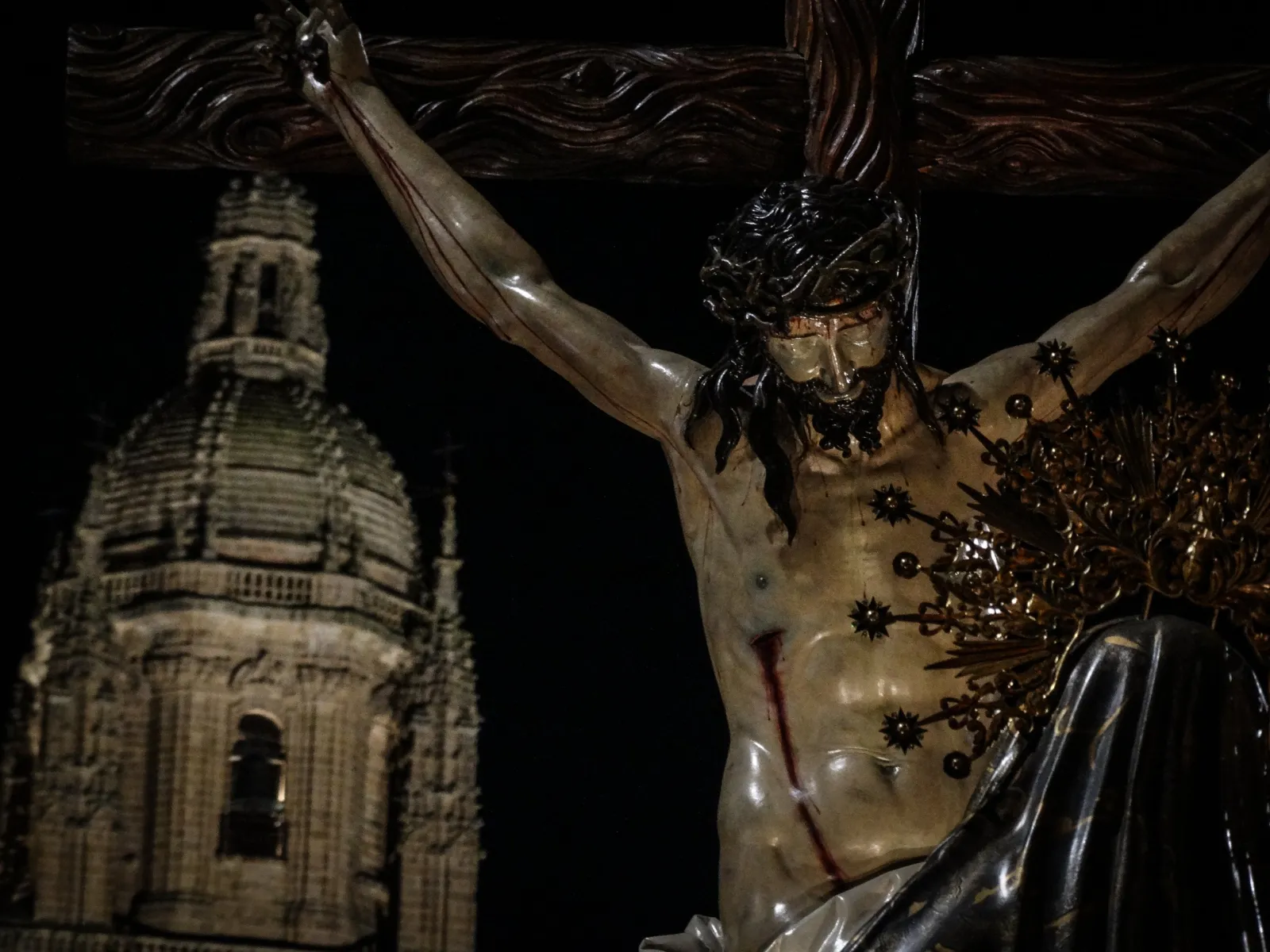
The Junta counts well over fifty pasos. The oldest image in the processions is the Cristo de la Agonía Redentora, a 16th-century crucifix attributed to Juan de Balmaseda, and the finest are 18th-century: Luis Salvador Carmona's Jesús Flagelado and Piedad, Felipe del Corral's Virgin of Sorrows and the groups Alejandro Carnicero carved for the Vera Cruz. The most venerated images are Jesús Rescatado, a 17th-century Christ, and Mariano Benlliure's Virgen de la Soledad (1941–1943), whose brotherhood has the most members in the city. In Salamanca the platforms the images ride on are called carrozas, and many are carved in walnut with plateresque motifs.
The university's Holy Week
The University of Salamanca plays its own part. On Holy Tuesday night the Hermandad Universitaria makes its promise of silence in the Patio de Escuelas, in front of the university's historic façade, and doctors in academic dress walk beside the paso. On Maundy Thursday and Good Friday the university holds its Holy Week liturgy in Latin in the Capilla de San Jerónimo of the Escuelas Mayores, attended by professors in gown and hood, while the Old Cathedral celebrates the Offices in the Mozarabic rite.
Styles side by side
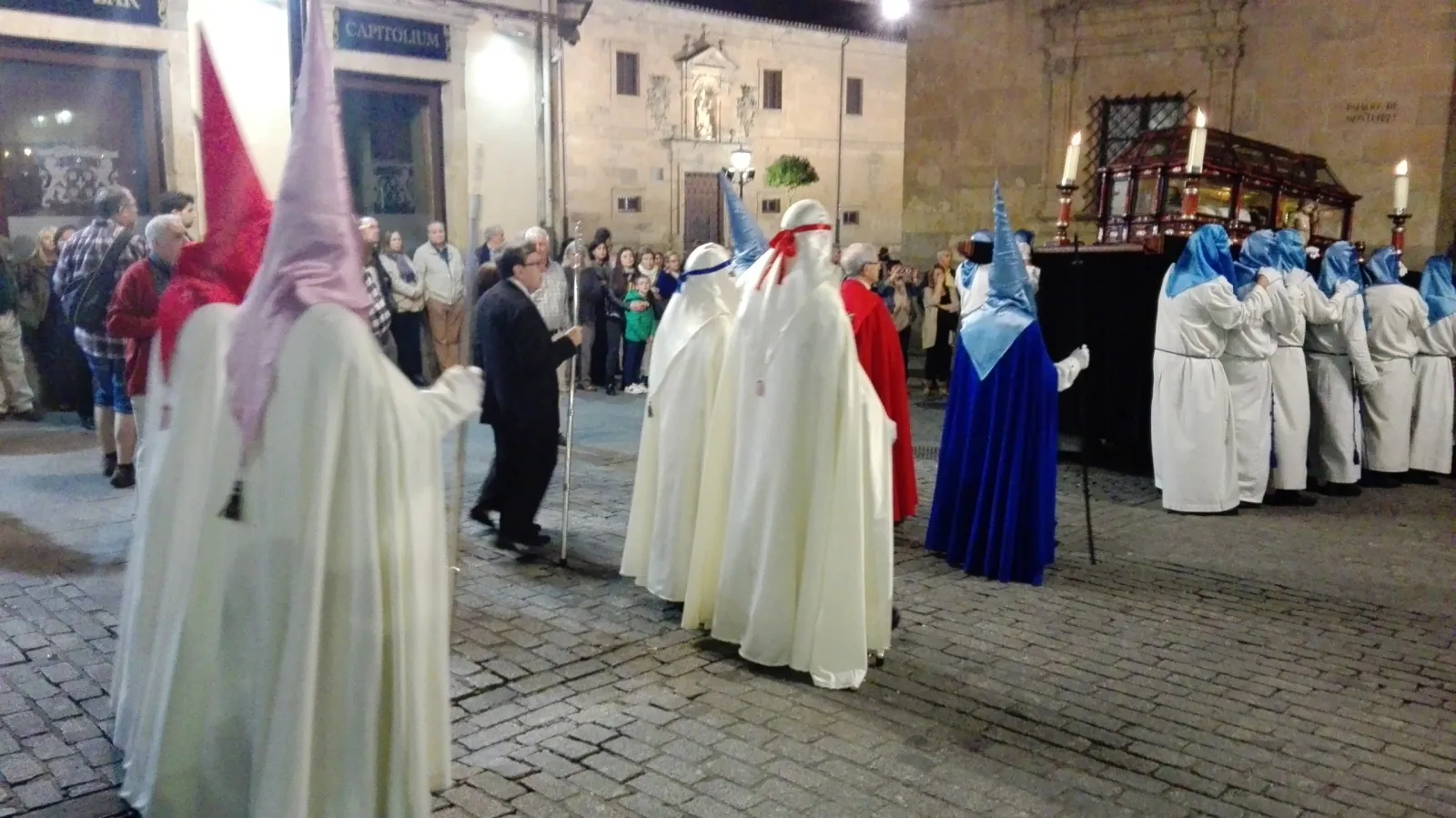
As a student city, Salamanca mixes styles, though austerity dominates. Some brotherhoods wear monastic habits instead of pointed hoods; the Hermandad Dominicana brings an Andalusian air to its early Good Friday procession; and charros in traditional Salamanca dress walk in several processions and dance in front of the risen Christ on Easter Sunday. Salamanca was also a pioneer in letting women carry the pasos, and in 2012 the Hermandad de Jesús Despojado brought out the city's first paso carried Andalusian-style, by costaleros beneath it.
Gallery
History & Origins
The oldest brotherhood is the Vera Cruz, formally founded in 1506 but with roots in the Hospital de la Santa Cruz set up by penitents around 1240. In 1576 King Philip II ruled that no other flagellant procession could be held in the city, which for centuries gave the Vera Cruz control of the processions from Holy Wednesday to Easter Sunday. In the baroque period it introduced the Descent from the Cross and the Holy Burial procession (1615), and the following year it founded the Easter procession that became today's Encuentro.
The 20th century brought ups and downs: no traditional processions went out in 1937, when Salamanca hosted the Nationalist headquarters in the Civil War; the 1960s and 1970s saw a crisis in the brotherhoods; and the 1980s and 1990s a strong revival. In the 1985 Holy Burial, two pasos were carried entirely by women for the first time in Spain, according to the history of the city's Holy Week. Today about ten thousand brotherhood members take part.
What to Expect
Most processions go out in the evening and at night, when the floodlit sandstone of the old town makes the best setting. The overall tone is sober: silence, drums and bands, and the slow progress of the pasos through narrow streets. Many pasos are shouldered by teams of men and women; a few large groups ride on wheeled floats pushed by members, and a handful of brotherhoods now use the Andalusian costal system.
Locals have nicknames for some figures, such as Bocarratonera for the soldier with ruined teeth in one of the Pilate scenes, or El Torero for a Christ whose pose recalls a bullfighter with his cape. Food is part of the week too: "limones", a Holy Thursday and Good Friday salad of lemon, orange, boiled egg, vinegar and pickled fish, plus torrijas, pestiños and, for children waiting at the kerb, wafers from the barquillero.
The Monday after Easter Monday is Lunes de Aguas, when Salamanca heads out to the countryside to eat hornazo, a bread pie filled with meat and sausage.
How to Get There
Train: Salamanca station has direct trains from Madrid, which is the easiest way in from the capital.
Bus: frequent coaches link Salamanca with Madrid and other cities in Castilla y León.
Car: the A-62 connects Salamanca with Valladolid and the A-50 with Ávila and Madrid. The historic centre is compact and best explored on foot; many streets close to traffic during processions.
Tips & Advice
- Book accommodation early: Holy Week is one of Salamanca's busiest weeks.
- Check each brotherhood's times and routes on the Junta de Semana Santa website before you go.
- Pick a spot on a narrow street of the old town for atmosphere, or by the cathedrals for the setting.
- Nights can be cold in March; bring a warm layer.
- Stay silent as the pasos pass and don't cross through a procession.
- More ideas in our Castilla y León guide.
Photos: Víctor Sánchez / CC BY 2.0 / Wikimedia Commons; Danisd75 / CC BY-SA 4.0 / Wikimedia Commons; لا روسا / CC BY-SA 4.0 / Wikimedia Commons
Semana Santa de Valladolid
Valladolid, Castilla y LeónValladolid's Semana Santa is the antithesis of Andalusia's exuberant celebrations. Here, silence and sobriety reign. The star of the show is the extraordinary collection of polychrome sculptures by Gregorio Fernández, 17th-century masterpieces of such realism they seem to breathe.
Semana Santa de León
León, Castilla y LeónSixteen brotherhoods, thousands of papones and pasos danced to the music in the Plaza Mayor: León's Holy Week, of International Tourist Interest, is austere in the street and sociable in the bars.
Holy Week in Zamora
Zamora, Castilla y LeónZamora's austere Castilian Holy Week fills ten days with 17 brotherhoods, more than 40 pasos, barefoot penitents and Miserere chants sung in the small hours in a Romanesque old town.
El Colacho (Baby-Jumping Festival)
Castrillo de Murcia, Castilla y LeónIn a small village near Burgos, a masked devil in yellow and red runs through the streets during Corpus week and, on the Sunday, leaps over rows of babies laid on mattresses before they are blessed.