Moors and Christians of Elda
Five days of Moorish and Christian pageantry in Elda (Alicante), with nine comparsas, two grand parades and gunpowder battles for a wooden castle. Declared of International Tourist Interest in 2026.
The days that matter
-
Thu 3 Jun usually 19:30 and 23:30
Entrada de Bandas and Retreta
The comparsa bands parade to the town hall and play the pasodoble Idella together. Late at night the festeros march in battle dress in the informal Retreta.
-
Fri 4 Jun usually 11:00 and 19:00
San Antón comes down and children's parade
In the morning the image of San Antonio Abad is carried from its hermitage to the church of Santa Ana. In the evening the children take over the parade route.
-
Sat 5 Jun usually 10:00 and 18:00
Moorish embassy and Entrada Cristiana
Arquebus fire and the Moorish embassy at the castle in the morning; the grand Christian parade in the afternoon and evening.
-
Sun 6 Jun usually 08:00, 11:00 and 18:00
Diana, flower offering and Entrada Mora
An early Diana, the flower offering to the saint at Santa Ana, then the grand Moorish parade in the afternoon.
-
Mon 7 Jun usually 10:00 and 18:30
Christian embassy and San Antón procession
The Christians retake the castle in the morning. In the evening the procession returns San Antón to his hermitage and fireworks close the fiesta.
What Moors and Christians of Elda is like
- Loud
- Procession
- Family
- Noise
- Bands all day and arquebus fire at the alardos
- Fire
- Gunpowder salvos and closing fireworks
- Crowds
- Packed parade routes at the weekend
- Mess
- You stay clean; just smoke at the alardos
- With kids
- Children's parade on Friday; ear protection for the gunpowder
Highlights
- The Entrada de Bandas on Thursday evening, when all the bands play Idella together in front of the town hall
- The two grand parades, Entrada Cristiana (Saturday) and Entrada Mora (Sunday), with each side's ambassador and boato
- The alardos and embajadas at the castle in Plaza de la Constitución, with arquebus fire and a hand-to-hand fight between the ambassadors
- The late-night Retreta, an informal parade in battle dress
- The closing procession of San Antón on Monday, ending with fireworks
Every year at the turn of May and June, Elda, an inland town in the Vinalopó valley of Alicante, hands its streets over to its Moros y Cristianos. In 2027 the fiestas run from Thursday 3 to Monday 7 June, according to the festival's official website. They always last five days, from Thursday to Monday, around the first Sunday of June.
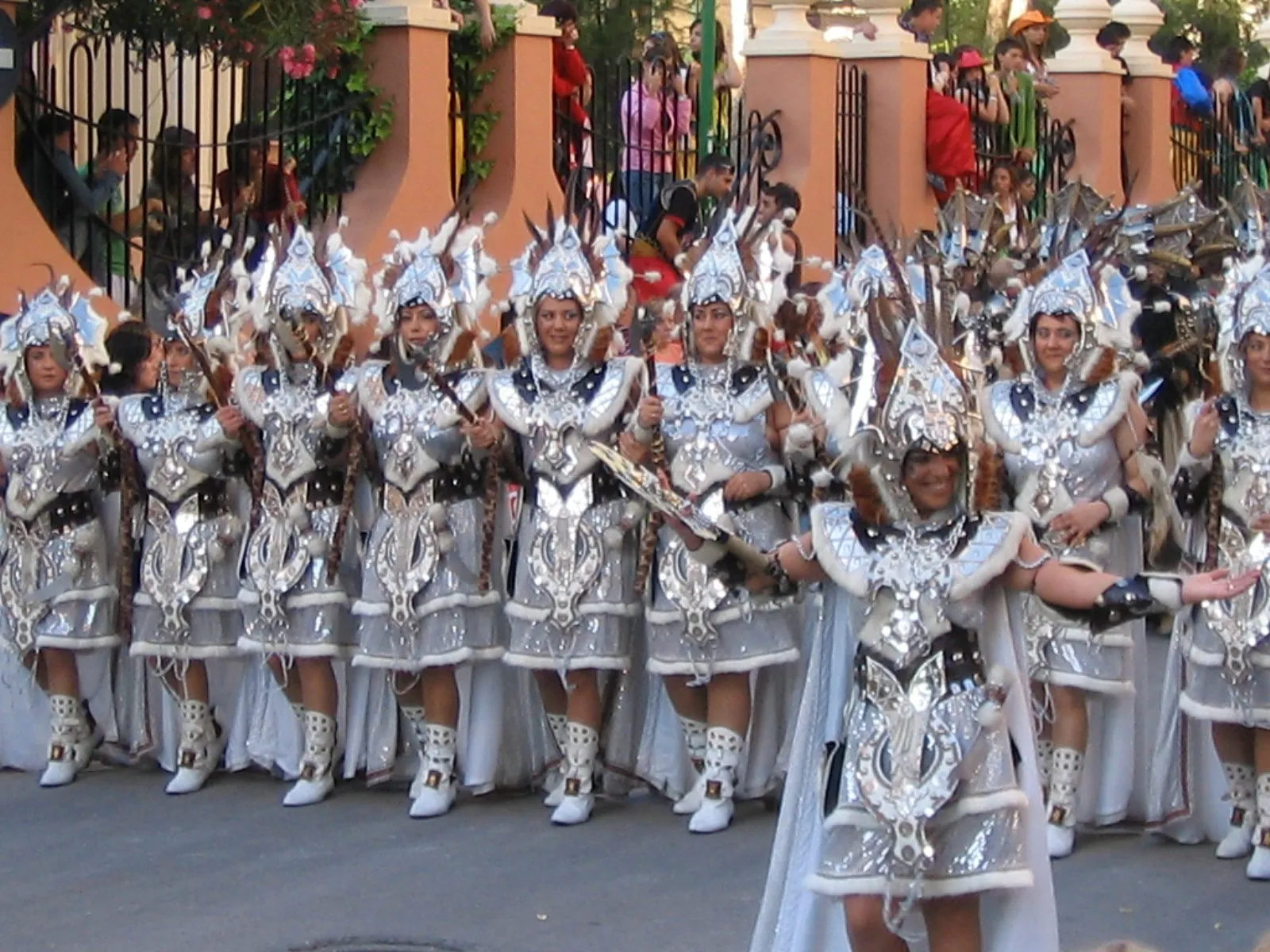
More than 7,000 festeros march in nine comparsas, and according to Spain's tourism ministry more than half of them are women; some comparsas have over a thousand members. The Moorish side is made up of the Huestes del Cadí, Marroquíes, Musulmanes and Realistas. The Christian side has the Contrabandistas, Cristianos, Estudiantes, Piratas and Zíngaros. Each comparsa has its own costumes, band and standard, and the order of the parades rotates every year.
Five days, two sides
The fiesta follows a set pattern. On Thursday the bands parade in and the whole town sings the pasodoble Idella, the hymn of the fiesta. On Friday the image of San Antonio Abad, the patron saint, is carried from its hermitage to the church of Santa Ana, and the children have their own parade. The weekend brings the two big parades: the Entrada Cristiana on Saturday afternoon and the Entrada Mora on Sunday afternoon, each led by its ambassador with a lavish boato of dancers, horses and floats.
On Saturday and Monday mornings the town hears gunpowder. In the alardo, festeros fire arquebuses along calle Colón towards the wooden castle in Plaza de la Constitución. Then the ambassadors hold their embajada, a verse dialogue that ends with one side taking the castle. The Moors win on Saturday and the Christians win it back on Monday.
Music and cuartelillos
Music holds the whole fiesta together. Each comparsa has marches and pasodobles of its own, and Elda's Certamen de Música Festera, a competition for new Moors and Christians music, reached its 38th edition in 2026; the ministry calls it the longest-running contest of its kind. Away from the parades, the fiesta lives in the cuartelillos, the decorated headquarters of each group of festeros, where members and visitors share food, drink and music, and in the night-time verbenas.
The Media Fiesta in January
The June fiesta has a winter prologue. Over two weekends around 17 January, the feast of San Antonio Abad, Elda holds its Media Fiesta: a bonfire and the blessing of animals and bread at the saint's hermitage, traditional dances, and a mass at Santa Ana where the standard-bearers and captains for June are proclaimed. It closes with a parade of ambassadors, comparsas and bands along the route of the Entradas, a foretaste of June.
Status
Spain declared the fiesta of National Tourist Interest in 2020 and raised it to International Tourist Interest by a resolution of 4 May 2026, published in the BOE on 6 June 2026. It is the 16th fiesta of International Tourist Interest in the Valencian Community and the 89th in Spain.
Where it happens
- Entradas and children's parade: from avenida Juan Carlos I through Plaza Sagasta, Jardines, Dahellos, Elia Barceló and Antonino Vera to Padre Manjón.
- Alardos and embajadas: calle Colón and Plaza de la Constitución, in front of the town hall, where the castle stands.
- Religious acts: the church of Santa Ana and the hermitage of San Antón.
History & Origins
The fiesta grew out of the soldadesca, a local militia that fired arquebus salutes in honour of the patron saint around 1838–1840. Elda-born statesman Emilio Castelar described those early celebrations in his Recuerdos de Elda o las fiestas de mi pueblo. The tradition faded in the last years of the 19th century.
It came back in the mid-1940s. In 1944 festeros paraded in costumes borrowed from neighbouring towns, and the first five comparsas were founded soon after. Until 1946 the fiesta was held around 17 January, the feast of San Antonio Abad. Today that date is marked by the smaller Media Fiesta, and the main celebration takes place in early summer.
The embassy texts date from the 19th century: an anonymous Moorish text from the Alcoy tradition and a Christian text by Francisco Laliga Gorgues. The children's parade was added in 1976.
What to Expect
Expect the whole town to be given over to the fiesta. The Entradas are long, colourful parades that run for hours from late afternoon into the night. The ambassadors ride at the front, followed by squads (escuadras) marching in step behind their band.
The mornings of the alardos are loud. Arquebus fire fills calle Colón with smoke and noise, so keep a distance from the shooters and protect children's ears. Sunday starts early with the Diana at 08:00 and the flower offering to the saint. On Monday evening the procession takes San Antón back to his hermitage.
The 2026 programme gives a good idea of the rhythm: Entrada de Bandas at 19:30 on Thursday, alardos at 10:00, Entradas at 18:00, and the closing procession at 18:30 on Monday. Check the official 2027 timetable before you go.
How to Get There
- Train: Elda-Petrer station has regional trains from Alicante; the centre is a short walk away.
- Car: Elda lies on the A-31 motorway between Alicante and Madrid, about 40 km inland from Alicante. Streets in the centre close for the parades, so park on the edge of town.
- Air: Alicante-Elche airport is the closest, under an hour away by road.
Tips & Advice
- For the Entradas, find a spot along avenida Juan Carlos I or the Jardines area well before 18:00; the route fills up early at weekends.
- The embajadas happen in a packed Plaza de la Constitución. If you want to hear the verses, arrive early and stand near the castle.
- Bring ear protection for the alardos, especially for children.
- Rooms in Elda and neighbouring Petrer are limited during the fiesta. Alicante is a practical base with trains to Elda-Petrer.
- Early June can be hot in the Vinalopó: carry water and a hat for the afternoon parades.
Noche de San Juan
Alicante, ValenciaNoche de San Juan (St. John's Eve) is Spain's most magical night. On 23 June, beaches and towns across the country light up with bonfires as millions of Spaniards celebrate the summer solstice with fire, sea, and ancient rituals. It's one of those rare festivals that unites the entire country in celebration.
Hogueras de San Juan Alicante
Alicante, ValenciaThe Hogueras de San Juan (Fogueres de Sant Joan in Valencian) is Alicante's answer to Valencia's Fallas — and it's every bit as spectacular. Each June, the city fills with enormous artistic monuments (hogueras) that are paraded, admired and ultimately burned to ashes on the magical Noche de San Juan. With daily fireworks, parades, bonfires on the beach and the deafening mascletà at noon, it's a festival of fire, art and Mediterranean joy. Declared a Festival of International Tourist Interest.
Las Fallas
Valencia, ValenciaLas Fallas is one of Spain's most spectacular and UNESCO-recognised festivals — a stunning combination of art, fire, music, and Valencian pride. Every March, the city of Valencia fills its streets with hundreds of enormous satirical sculptures (fallas), only to burn them all to the ground in a magnificent midnight inferno on the final night.
Moros y Cristianos
Alcoy, ValenciaThe Moros y Cristianos (Moors and Christians) festivals are among Spain's most visually spectacular celebrations — elaborate historical re-enactments of the medieval battles between Christian and Muslim forces, performed with extraordinary costumes, gunpowder, music, and drama across dozens of cities and towns, primarily in the Valencia region and Andalusia.