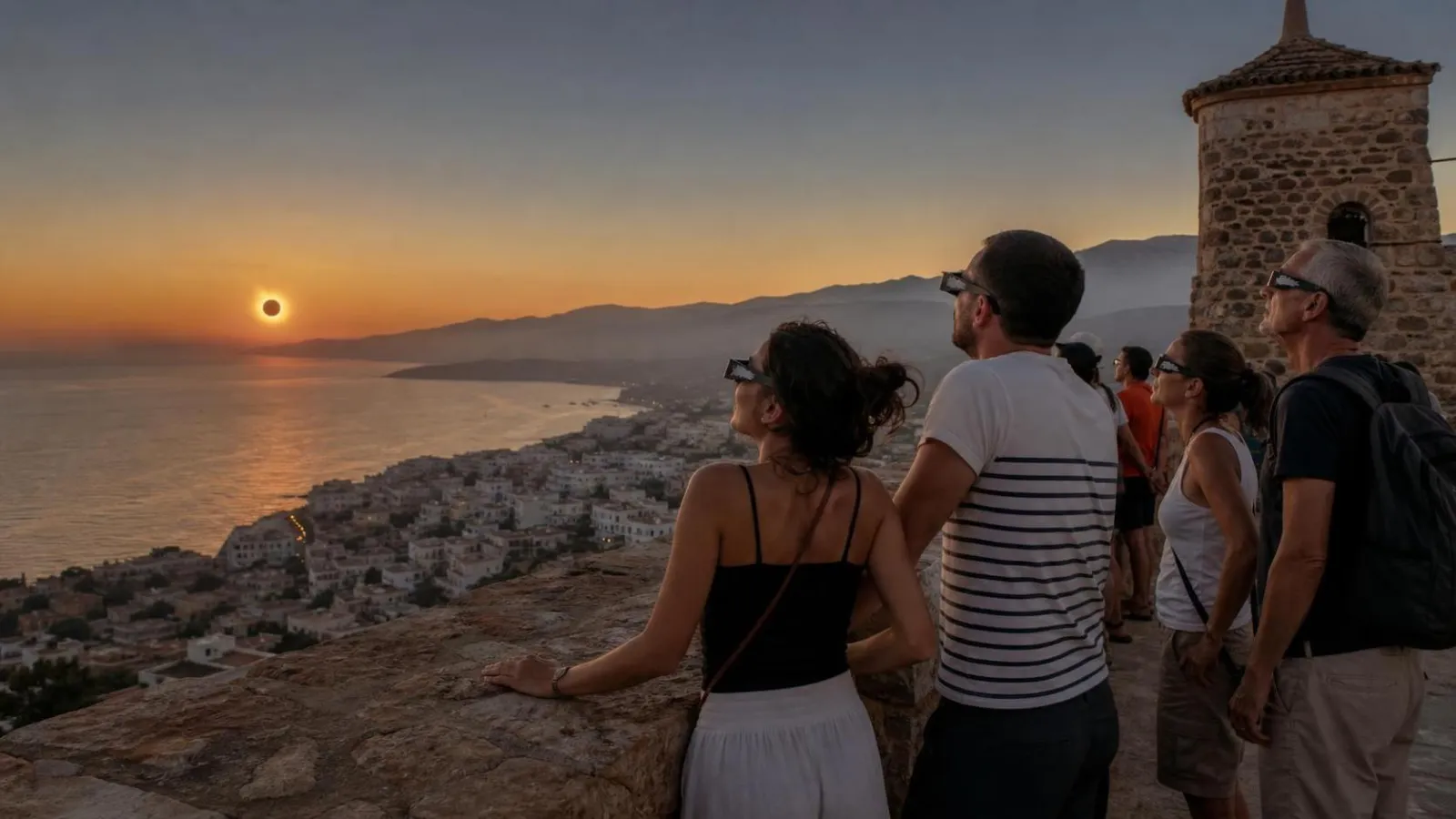
Total Solar Eclipse in Spain 2026: Where to Watch
On 12 August 2026, a total solar eclipse will cross parts of Spain near sunset. This guide explains where to watch, how to plan travel, what to expect in cities outside the path of totality, and how to view the eclipse safely.
Spain will be one of the best places in Europe to experience the total solar eclipse on 12 August 2026. The event is often confused with a lunar eclipse, but this one is solar: the Moon will pass between Earth and the Sun, and locations inside the narrow path of totality will see the Sun briefly covered.
For travellers, the timing makes the eclipse especially dramatic. In Spain it happens in the evening, close to sunset, so the best viewing spots will need a clear, low western horizon as well as cloud-aware planning. Hotels, trains and rural accommodation in the path are likely to fill early, especially in coastal and mountain areas.
Quick facts
- Date: Wednesday, 12 August 2026.
- Event: Total solar eclipse, not a lunar eclipse.
- Best Spanish viewing zone: parts of northern Spain, inland north-central Spain and the Balearic Islands.
- Timing: evening in Spain, close to sunset; exact local times depend on the town.
- Key requirement: a clear view toward the western horizon.
- Safety: use certified solar eclipse glasses whenever any part of the Sun is visible.
Where to watch the 2026 eclipse in Spain
The path of totality is expected to cross parts of Spain from the northwest toward the Mediterranean. Good planning areas include Galicia, Asturias, Cantabria, Castilla y Leon, Aragon and the Balearic Islands. Exact viewing quality will vary by town, weather and horizon.
Do not choose a destination only because it is inside the eclipse path. In August, local weather, traffic, parking and the angle of the sunset matter just as much. A town with a slightly shorter totality but a clean horizon can be better than a famous city where buildings, hills or haze block the view.
Best planning bases
Northern Spain: Asturias and Cantabria are attractive because they combine coastal viewpoints, mountain scenery and established summer tourism infrastructure. The risk is Atlantic cloud, so build flexibility into the itinerary and compare inland and coastal options in the final 48 hours.
Castilla y Leon and Aragon: Inland locations may offer broader horizons and easier driving routes. They can also be very hot in August, so plan shade, water and a realistic return journey after the event.
Balearic Islands: Mallorca and nearby islands are likely to be popular because the eclipse combines well with a summer holiday. Book early and check that the chosen beach, lookout or rural stay has an open western view.
What about Madrid, Barcelona and Valencia?
Many major Spanish cities will still see a deep partial eclipse, but partial is not the same experience as totality. If the goal is darkness, the corona and the full total-eclipse moment, plan to be inside the official path of totality. If staying in Madrid, Barcelona, Valencia or another city outside the path, treat it as a partial eclipse and use solar glasses throughout.
How to plan the trip
- Choose 2-3 possible viewing areas instead of one fixed spot.
- Book accommodation with free cancellation where possible.
- Check train and road options early; the best towns may have limited capacity.
- Arrive the day before if you are aiming for a rural or coastal viewpoint.
- Use the Spanish festivals calendar to combine the eclipse with nearby August events.
- On the day, scout the horizon before the afternoon crowds arrive.
Safe viewing checklist
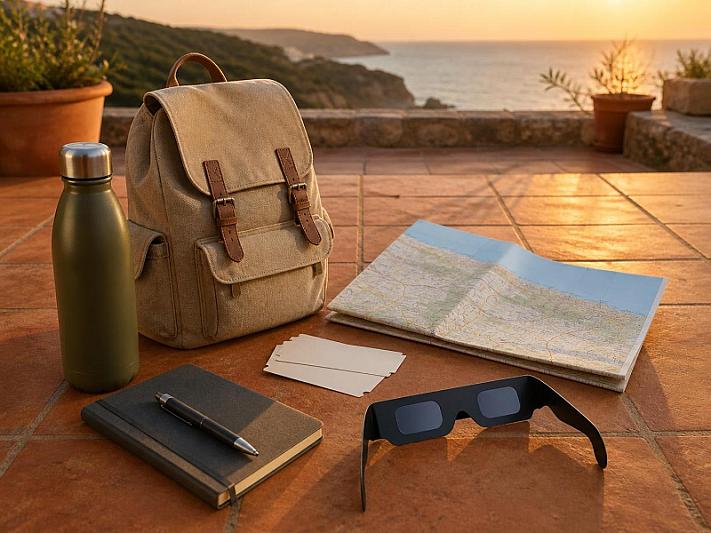
Never look directly at the Sun without proper protection. Ordinary sunglasses, smoked glass, camera filters and phone screens are not safe substitutes. Use eclipse glasses that meet the ISO 12312-2 standard and inspect them for scratches or damage before the event.
During the brief period of totality, people inside the path may be able to look without glasses only when the Sun is completely covered. As soon as any bright edge returns, glasses must go back on. If you are outside the path of totality, there is no safe naked-eye moment.
Photography tips
A phone can capture the mood, the crowd and the changing light, but it will not replace a solar-filtered camera for close-up eclipse images. If you plan to photograph the Sun, use a proper solar filter before and after totality. For most travellers, the better choice is simple: take a few wide shots, then watch the eclipse with your own eyes when it is safe.
Weather and horizon strategy
Because the eclipse is low in the sky, the horizon is critical. Look for open coastlines, high viewpoints with a clear west-facing angle, plains or rural roads away from tall buildings. Avoid narrow old-town streets unless you already know the Sun will be visible from that exact location.
Check weather models only as the date approaches. A year out, climate patterns can guide broad choices; a week out, forecasts become useful for route planning; in the final 24-48 hours, cloud cover and haze should decide the exact viewing spot.
FAQ
Is the eclipse on 12 August 2026 lunar or solar?
It is a solar eclipse. The Moon will pass in front of the Sun. A lunar eclipse happens when Earth casts its shadow on the Moon, which is a different event.
Will the eclipse be visible everywhere in Spain?
A partial eclipse should be visible across much of Spain, weather permitting. Totality is limited to a narrower path, so travellers need to check the exact map before choosing a destination.
Do I need eclipse glasses?
Yes. Use certified solar eclipse glasses whenever any part of the Sun is visible. Outside the path of totality, keep them on for the entire observation.
Should I book now?
If you want to stay in a small town, coastal area or island location inside the path, early booking is sensible. Choose flexible reservations because final weather decisions may change the best viewing location.
Bottom line
The 12 August 2026 eclipse is a rare reason to plan a summer trip around the sky. Pick a region inside the totality path, keep the western horizon in mind, protect your eyes and leave room to move if the weather changes. Done well, it can be one of the most memorable travel moments in Spain that year.
Related Articles

San Andrés in Tenerife: Tablas de Icod & New Wine
A practical guide to the San Andrés traditions of north Tenerife: the Tablas de Icod, new wine, chestnuts and Puerto de la Cruz cacharros. The traditional dates are 29–30 November; exact 2026 routes and times were still awaiting municipal publication on 22 October.
Fiesta del Orujo in Potes 2026: What to Do in the Picos
Potes celebrates the Fiesta del Orujo on 13–15 November 2026, dates confirmed by the town council. This visitor guide covers Potes, Liébana and the recurring festival traditions; the detailed 2026 timetable was still pending on 22 October.

Zambombas de Jerez 2026: Flamenco Christmas Guide
A practical guide to the Zambombas de Jerez: what the flamenco Christmas gatherings are, the neighbourhoods to explore and how to use the municipal calendar. The exact 2026 programme and authorised dates were not yet published as of 22 October; confirm them on the official Jerez Christmas site before booking.