Águilas Carnival
Murcia's great carnival, of International Tourist Interest since 2015: a half-wild beast let loose from the castle, battles fought with confetti-filled eggshells and parades of feathered costumes down to the port.
The days that matter
-
Sat 30 Jan
Gala del Cambio de Poderes
Last year's characters hand over to the new Musa, Don Carnal, Doña Cuaresma and Mussona, opening the carnival.
-
Thu 4 Feb late evening
Suelta de la Mussona
The beast is released from the castle of San Juan de las Águilas and led down to Plaza de España by the musician-tamer.
-
Fri 5 Feb
Children's battle and Mussona
Child versions of the characters fight their own cascarones battle in Plaza de España.
-
Sat 6 Feb
Battle and pregones
Don Carnal defeats Doña Cuaresma amid flying cascarones, then the Musa and guest speaker open the fiesta from the town hall balcony.
-
7–9 Feb
Parades and Carnaval de la Noche
Peñas parade to the port; on Monday night the whole town takes to the streets in costume around Plaza de España.
-
Sat 13 Feb
Last parade and burning of Don Carnal
After the Sábado de Piñata parade, Don Carnal burns on the beach with fireworks, followed by the prize-giving.
-
Sat 20 Feb
Chirigota contest
The official close of the carnival.
What Águilas Carnival is like
- Carnival
- Night
- Loud
- Messy
- Noise
- Bands, conch shells, firecrackers and street parties at night
- Fire
- Fireworks and the burning of Don Carnal on the last Saturday
- Crowds
- Huge crowds on parade Saturdays in a small coastal town
- Mess
- Confetti from the cascarones ends up everywhere
- With kids
- Children's battle and Mussona; the night carnival is for adults
Highlights
Suelta de la Mussona: the beast is released from the castle and led down to Plaza de España
The battle between Don Carnal and Doña Cuaresma, fought with thousands of confetti-filled eggshells
Pregones from the town hall balcony
Four big parades of peñas, comparsas and floats down to the port
Carnaval de la Noche, when the whole town dresses up
The burning of Don Carnal on the beach, with fireworks
Águilas Carnival 2027: 30 January – 20 February
The Federación de Peñas del Carnaval de Águilas has announced that the 2027 carnival runs from 30 January to 20 February 2027. The core is the week around Shrove Tuesday (9 February 2027): it starts on Thursday 4 February with the release of the Mussona, ignites on Saturday 6 February with the battle between Don Carnal and Doña Cuaresma, and ends unofficially on Saturday 13 February with the burning of Don Carnal on the beach. Galas before and the chirigota contest after stretch it to three weeks. Check the federation's programme for exact times.
What makes it different
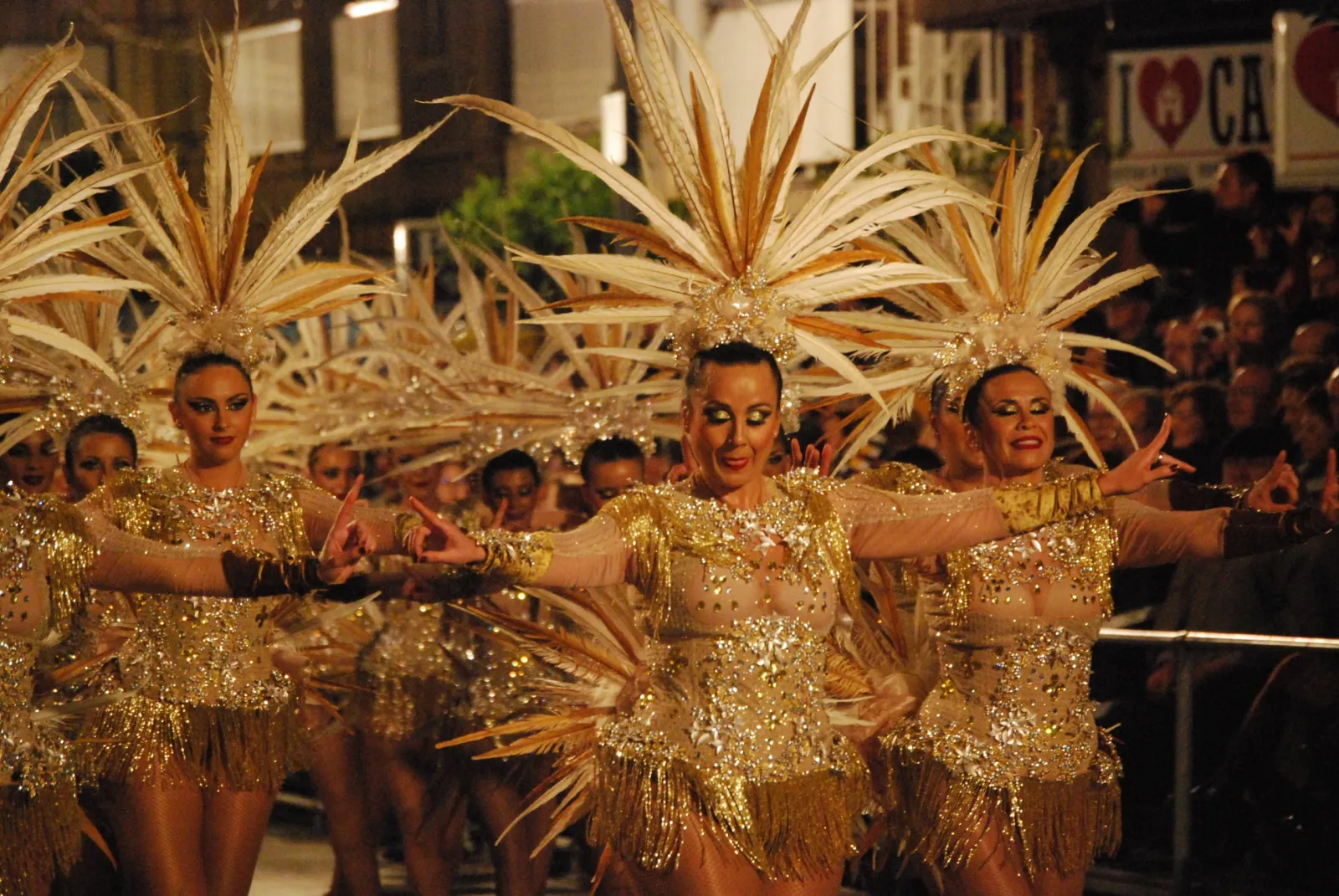
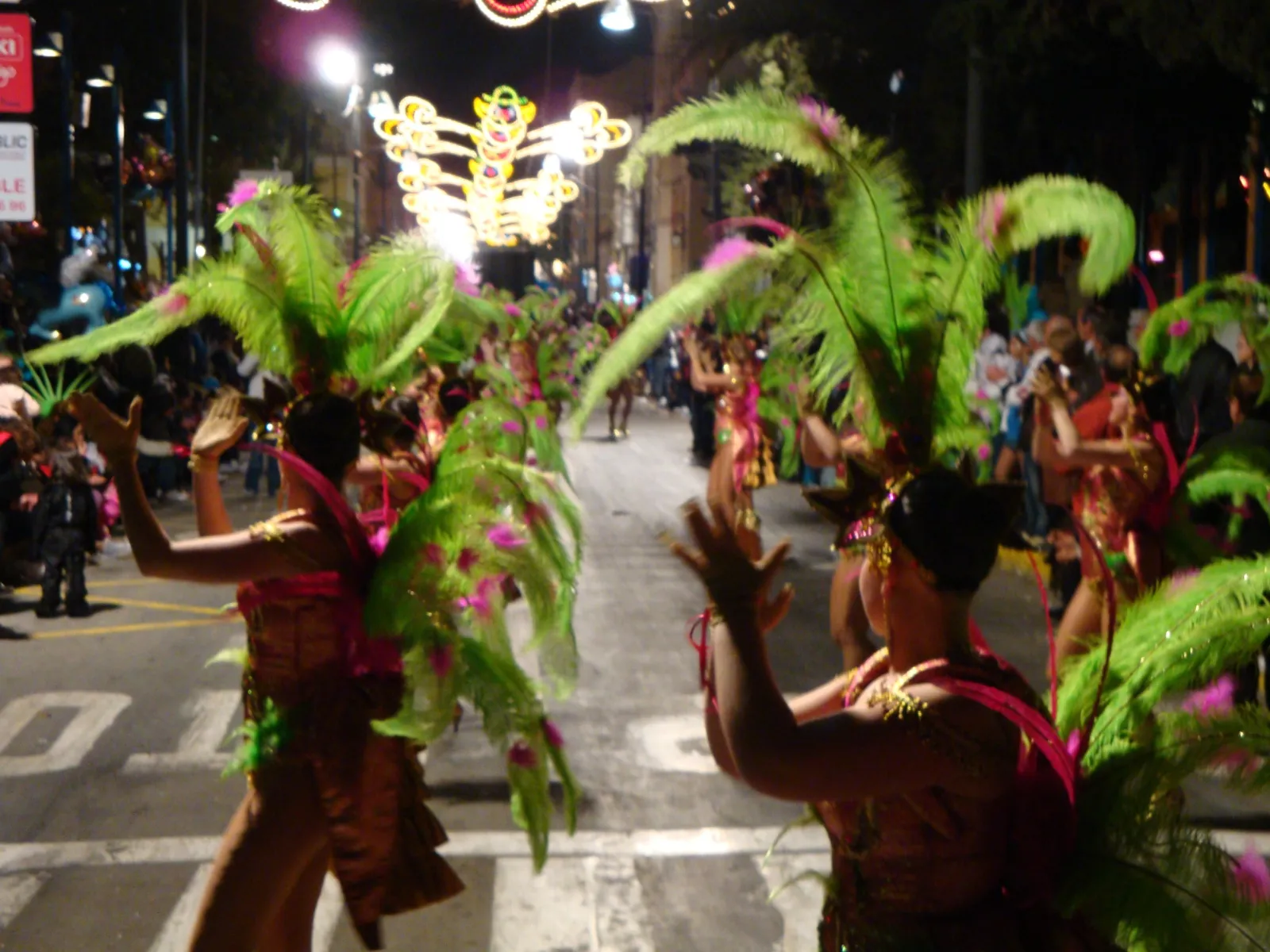
Águilas, a fishing town on the Murcian coast, was declared a Fiesta de Interés Turístico Internacional in 2015, the third carnival in Spain to reach that status after Santa Cruz de Tenerife and Cádiz. Its carnival has two faces. By day, the peñas parade elaborate costumes of feathers, sequins and fantasy, with choreographies and floats, from the Puerta de Lorca down to the port and the statue of Icarus. One parade is given over to visiting troupes from across Spain, who compete in a national contest of guest comparsas: 38 took part in 2024.
By night, the whole town dresses up. The Carnaval de la Noche peaks on carnival Monday in Plaza de España, Calle Rey Carlos III, Calle Coronel Pareja, Calle Castelar and Plaza Doctor Fortún, known as El Placetón. Costumes are mostly home-made, many people perform little sketches in character, and a stage in the square hosts contests for individuals and groups. In 2018 this night carnival received the Caracola de Oro award as a tribute to the people of Águilas.
The four characters
The Musa embodies the carnival spirit; Don Carnal wins a week of revelry from Doña Cuaresma, who takes her revenge when he burns. They are chosen each year at a gala in which the peñas take part. And the Mussona, a half-human, half-beast figure, is the town's own: once a year it is released from the dungeons of the San Juan de las Águilas castle and storms down to the square while the crowd chants "Mussona-na!". It is the only one of the four that can be played by a man or a woman, and its costume must be made from esparto and natural materials from the sea or the land, such as palm, tow and shells.
Cascarones and cuerva
Two traditions bind it all. The cascarones are eggshells that bars, restaurants and families save all year: opened at one end, emptied, dried, filled with paper confetti and sealed with tissue paper. Before the battle, users of the Centro Ocupacional Urci and the AFEMAC association hand over the cascarones they have made to the two courts as their "weapons". The cuerva is the carnival punch: red and white wine, spirits, vermouth, fizzy drinks, sugar, cinnamon and fruit. Veterans say it began as a way to use up the bottles left over from Christmas; it tastes mild and is anything but.
Gallery
History & Origins
The organisers trace the carnival back more than 200 years. The oldest photographs date from 1903, oral memory reaches the first third of the 19th century, and historians link the custom to the founding of the town under Charles III in the 18th century. Municipal ordinances of 1886 already regulated masked revellers. Carnival was banned under Franco, but some locals kept dressing up with small tricks, such as staging mock weddings.
Old customs survive in today's fiesta. The cascarones have a long Mediterranean history, the burning of Don Carnal revives the old burning of a straw figure, and the Mussona recalls a man-bear figure in esparto, led by a musician with a tambourine, that chased children and girls through the streets. The carnival grew into the town's main fiesta and in January 2015 the State Secretariat for Tourism declared it a Fiesta de Interés Turístico Internacional.
What to Expect
The Suelta de la Mussona is the most original night. In a ritual at the castle, the previous year's Mussona, now the musician-tamer, hands its power to the new one; the beast is then let loose and led down to Plaza de España, leaping at windows and scaring onlookers, while hundreds follow blowing conch shells. It reached the square at around 23:45 in 2026, ending with a big firecracker display.
On carnival Saturday the two courts march to Plaza de España for the battle: Don Carnal and Doña Cuaresma trade verbal blows while their followers throw cascarones; the organisers estimate around 25,000 between the children's and adults' battles. Don Carnal wins, the Musa, the mayor and a celebrity give their pregones from the balcony, and the party begins.
The parades run from the Puerta de Lorca crossing (Calle Caridad and Avenida Juan Carlos I) along Calle Rey Carlos III and Plaza de España to Calle Coronel Pareja by the port. Chairs and boxes along the route are sold in advance. The organisers have reported more than 200,000 people on the busiest Saturday, so expect packed streets. The last parade, on the Saturday after Ash Wednesday, ends on the beach with the burning of Don Carnal, fireworks and the prize-giving in Plaza de España.
How to Get There
Águilas is on the southern coast of the Region of Murcia, next to the border with Almería.
- By air: the nearest airports are Región de Murcia International (Corvera) and Almería; Alicante has more international flights but is further away.
- By train: Águilas has a station on the Cercanías line from Murcia via Lorca, but the line has been affected by long engineering works with replacement buses, so check Renfe before you travel.
- By car: the town is reached by motorway from Lorca and Murcia. On parade days the centre is closed to traffic; the federation publishes a map of car parks.
Tips & Advice
- Check the programme on the Federación de Peñas website in January: it confirms days and times for each act.
- Buy parade chairs or a box in advance if you want to sit; the galas (Cambio de Poderes, paper costumes, body painting, drag queen) also need tickets.
- Bring a costume for the night, even a simple one: in Águilas almost nobody goes out undressed.
- Keep children close at the Suelta de la Mussona, which is designed to scare, and expect confetti in your hair after the battle.
- The cuerva tastes mild but is strong: pace yourself.
- Rooms fill fast for the carnival weekends: book early or stay in Lorca or along the coast.
Photos: ConchiArroyo / CC BY-SA 4.0 / Wikimedia Commons; Mistersasou / CC BY-SA 3.0 / Wikimedia Commons
Entierro de la Sardina de Murcia
Murcia, MurciaMurcia's Entierro de la Sardina is one of Spain's most unique spring festivals. A surreal parade where thousands of toys are thrown from floats, giant sardine effigies are burned, and fireworks light up the night. Declared a Fiesta of International Tourist Interest.
Bando de la Huerta
Murcia, MurciaOn the Tuesday after Easter the whole of Murcia dresses as market gardeners for the Bando de la Huerta, the big day of the city's Spring Festival, with a flower offering, food stalls and a parade that throws snacks to the crowd.
Wine Horses of Caravaca (Fiestas de la Vera Cruz)
Caravaca de la Cruz, MurciaFrom 1 to 5 May, Caravaca de la Cruz honours its True Cross with Moors and Christians and the UNESCO-listed Wine Horses: some 60 horses in embroidered silk and gold, each racing up the castle slope with four runners clinging on.
Carthaginians and Romans Festival
Cartagena, MurciaTen days in which thousands of Cartagena residents become Carthaginian troops and Roman legions to replay the city's history from its founding as Qart Hadasht to Scipio's conquest in 209 BC.