Wine Horses of Caravaca (Fiestas de la Vera Cruz)
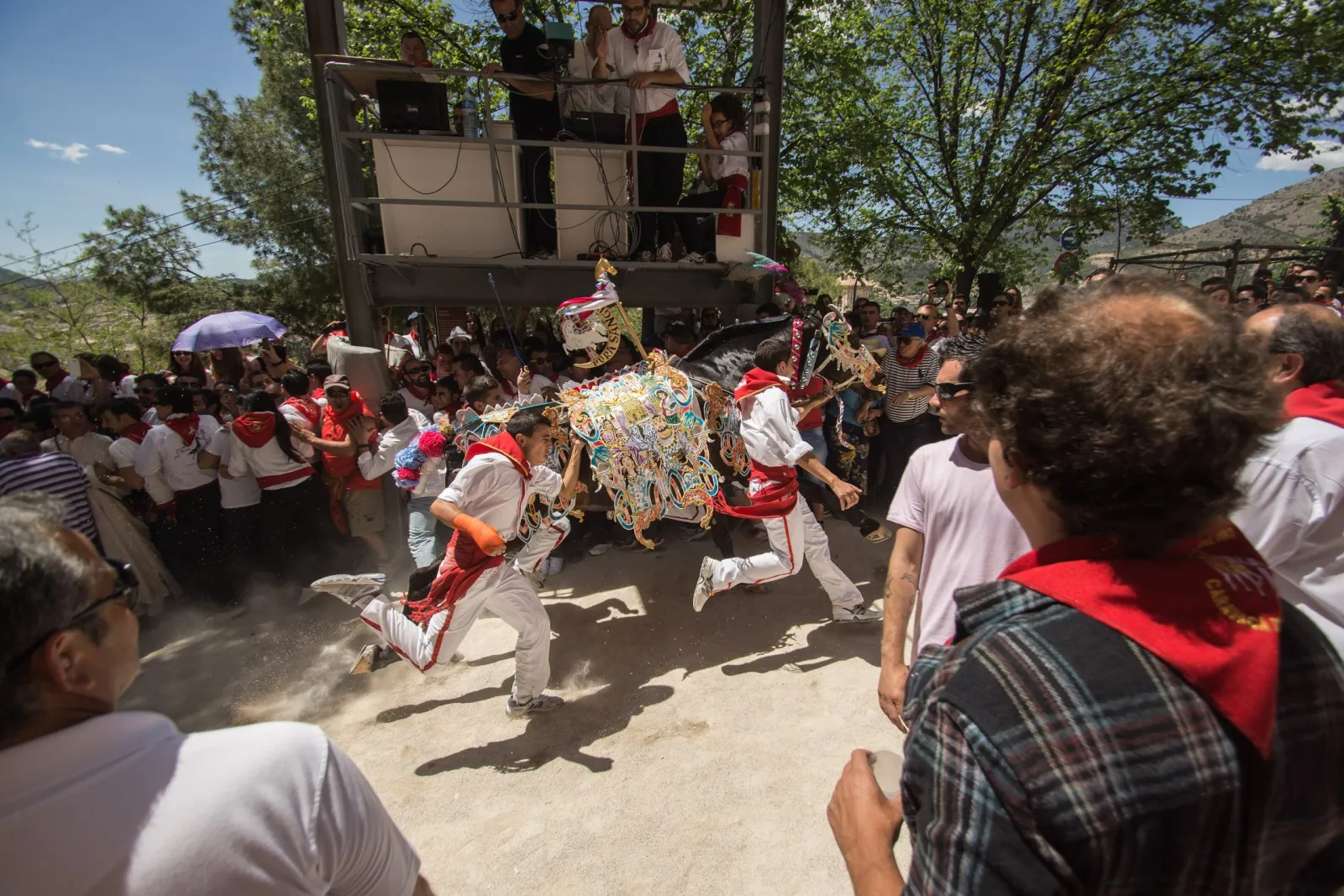
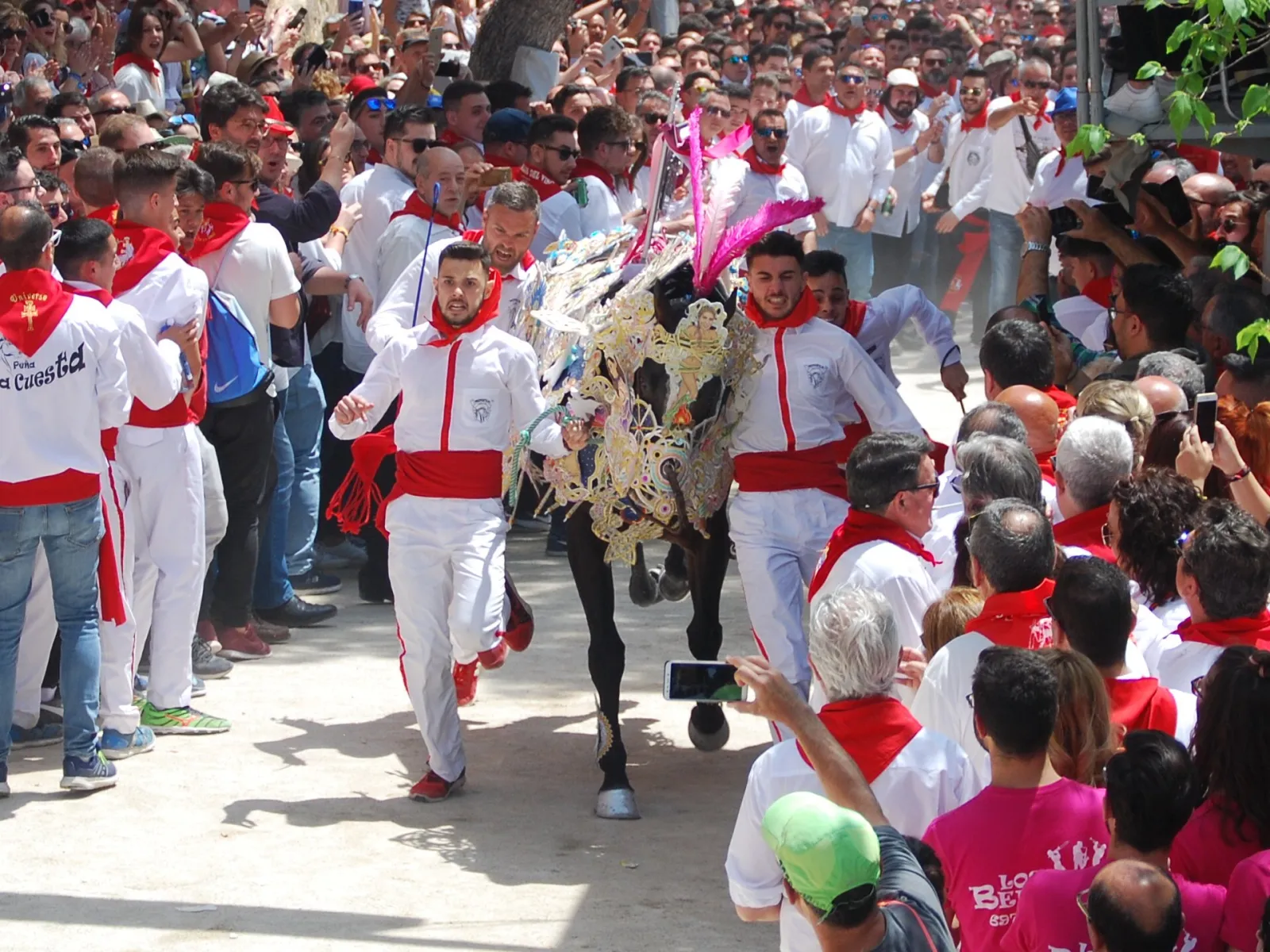
From 1 to 5 May, Caravaca de la Cruz honours its True Cross with Moors and Christians and the UNESCO-listed Wine Horses: some 60 horses in embroidered silk and gold, each racing up the castle slope with four runners clinging on.
The days that matter
-
1 May afternoon
Bareback horses and embroidery
Flower offering at the castle, bareback horse contest in Plaza del Hoyo and embroidered mantles on display along the Gran Vía.
-
2 May 12:00
Horses at the Glorieta
After the Mass at the Templete and the neighbourhood parade, about sixty horses gather before heading to the castle.
-
2 May from 14:00
The race and the wine bath
The Cross is dipped in wine at the sanctuary as the horses race up the castle slope one by one.
-
3 May 20:30–21:15
Baño de la Cruz
Moors and Christians parley and fight in Plaza del Bañadero, then the Cross is bathed at the Templete.
-
4 May 20:00
Gran Parada
The big Moors and Christians parade along the Gran Vía, with bands and choreographed groups.
-
5 May 21:15
Blessing of the countryside
Procession up to the sanctuary; the Cross blesses the town and fields from the battlements, then fireworks.
What Wine Horses of Caravaca (Fiestas de la Vera Cruz) is like
- Loud
- Procession
- Free
- Noise
- Bands, cheering peñas and gunpowder salutes from the castle
- Fire
- Fireworks to close the festival on 5 May
- Crowds
- The castle slope is packed solid for the race
- Mess
- You stay clean; mind the horses
- With kids
- Great for the parades; the race crowd is no place for small kids
Highlights
- The race up the castle slope on 2 May, each horse with four runners clinging on
- Some sixty horses together at the Glorieta on 2 May at noon
- Mantles embroidered with silk, stones and gold and silver thread
- The bareback horses and the embroidery exhibition on 1 May
- The Baño de la Cruz at the Templete on the evening of 3 May
- The Moors and Christians Gran Parada on 4 May
Fiestas de Mayo 2027: dates
Caravaca de la Cruz celebrates its patron festival in honour of the Santísima y Vera Cruz from 1 to 5 May every year, so the 2027 edition runs from Saturday 1 to Wednesday 5 May 2027, the dates listed by the Murcia regional tourism board. The big day of the Caballos del Vino is Sunday 2 May. The times below follow the traditional programme published by Caravaca's tourism office; check the final 2027 schedule closer to the date.
Horses, wine and a holy cross
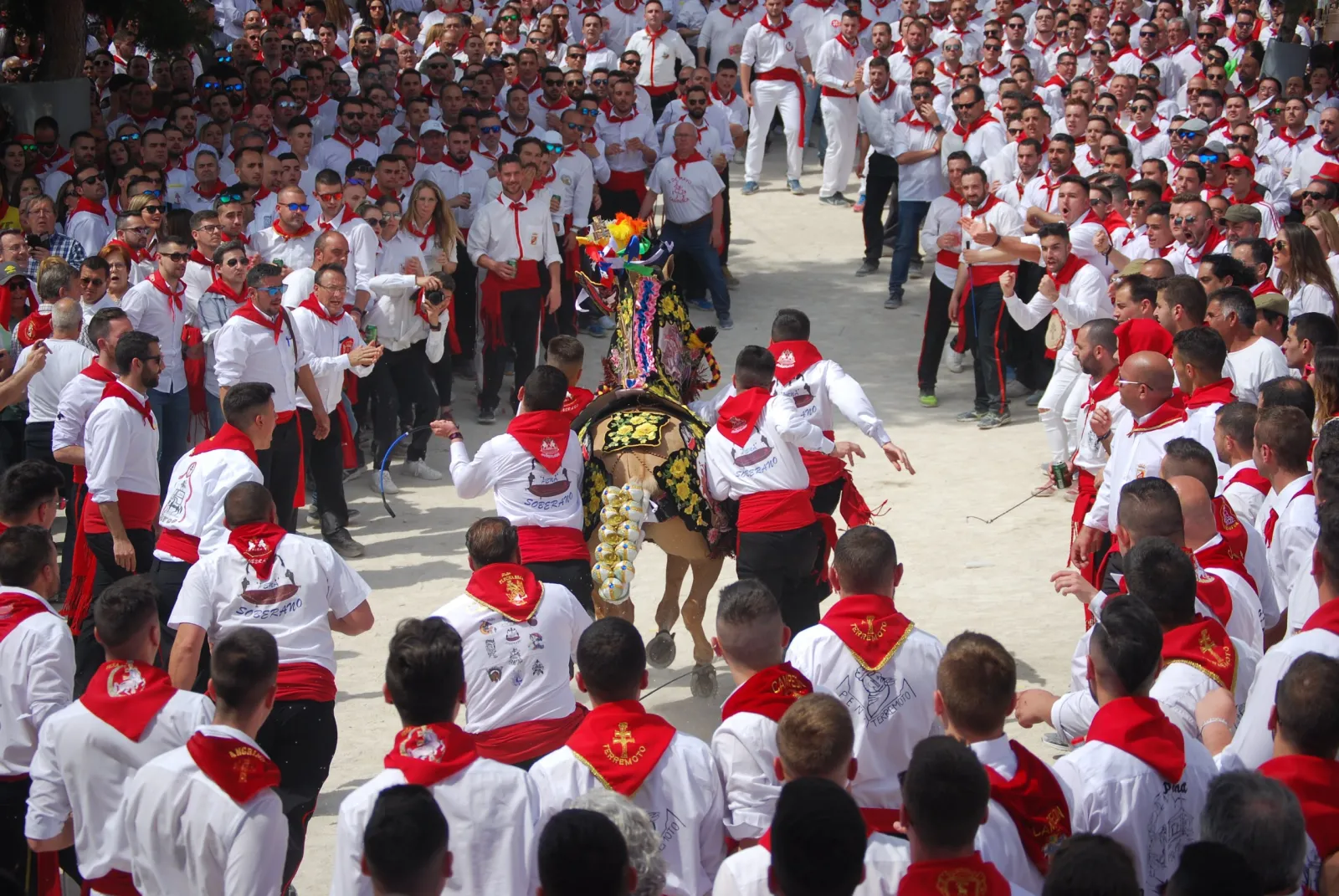
The Fiestas de Mayo are a Festival of International Tourist Interest, and on 16 December 2020 UNESCO inscribed the Caballos del Vino on its list of Intangible Cultural Heritage of Humanity. Their origin is linked to one of the festival's oldest rituals, the blessing of wine and flowers by the Vera Cruz, and tradition ties them to a medieval siege, when Christian knights broke through the Moorish lines at a gallop to carry wineskins to the thirsty defenders of the castle. Today around sixty horses, each belonging to a peña and run by four caballistas on foot, take part in three contests: the bareback horse (caballo a pelo), the harness (enjaezamiento) and the race.
1 and 2 May: the Day of the Horses
On the morning of 1 May people, many in Murcian huertano dress, bring flowers to the esplanade of the castle sanctuary for the Vera Cruz. In the afternoon the horses arrive bareback in the old Barrio del Hoyo, the cradle of the festival, for the contest in Plaza del Hoyo, and the embroidered mantles are displayed along the Gran Vía.
On 2 May caballistas start dressing the horses at 4 a.m.; at 7 a.m. bells and gunpowder salutes from the castle open the day. The horses go to the open-air Misa de la Aparición at the Templete, which recalls the appearance of the Cross in 1231, parade through their neighbourhoods and gather at the Glorieta, the best chance to see all of them up close. At 2 p.m., while the Cross is dipped in wine and the flowers are blessed in the sanctuary, the horses begin to race up the castle slope one by one, every three to five minutes, with their four runners hanging on. Each run is timed, and it only counts if none of the four lets go. The harness prize follows on the castle esplanade, and that evening the Cross comes down from the castle in procession, escorted by Moors and Christians, to spend the next nights in the town.
3 to 5 May: the Cross and the Moors and Christians
On 3 May, after the Mass of the Cross in the church of El Salvador and a children's parade, the Moorish and Christian kings stage a parley and a mock battle in Plaza del Bañadero. Then comes the solemn Baño de la Cruz at the Templete, where the Cross is dipped under the arches of the monument to bless the waters, a rite more than 600 years old. On the morning of 4 May the Cross visits the homes of sick and housebound people, and in the evening Moorish kábilas and Christian groups march with their bands in the great Moors and Christians parade along the Gran Vía. On 5 May the Cross returns to its sanctuary and blesses the town and the countryside from the castle walls, towards the four points of the compass, before fireworks close the fiesta.
Gallery
History & Origins
The festival grew around the Vera Cruz, the double-armed cross venerated in Caravaca's castle sanctuary. According to tradition it appeared in 1231 before the Muslim ruler Ceyt Abu-Ceyt, who converted to Christianity, an event recalled every 2 May in the Misa de la Aparición. The oldest rite is the bath of the Cross in water to bless it, said to have begun in the 14th century when water touched by the Cross was spread over fields to fight plagues of locusts; according to the tourism office, the route taking the Cross out to the irrigation channels beyond the walls has been followed since 1384.
The blessing of wine and flowers gave rise to the Caballos del Vino. The Moors and Christians took shape in the mid-19th century, replacing the old soldadesca that fired gunpowder around the Cross until it was banned in 1842. After decades of decline the fiestas were renewed in 1959, when the first Moorish and Christian groups and many of today's peñas were founded. The horses' harness evolved from bridal bedspreads and Manila shawls lent by mothers and sisters into today's mantles embroidered with silk, stones and gold and silver thread, made to measure and renewed every year; designer Dolores Michelena shaped much of that style. The Fiestas de la Santísima y Vera Cruz were declared of International Tourist Interest in 2004, and the Caballos del Vino became UNESCO Intangible Cultural Heritage on 16 December 2020. Horse handling is still passed down in families, and embroidery in workshops.
What to Expect
2 May is a long, intense day. The race itself lasts a few seconds per horse but goes on for hours, as some sixty horses run one by one; the crowd lines the slope so tightly that space barely opens as each horse passes. Caravaca's tourism office advises caution and never standing in the middle of the course, where the horses need room.
Each horse belongs to a peña and a neighbourhood, and rivalry is fierce: when a winner is announced, the whole group erupts in hugs and music. The faces embroidered on many mantles are those of real people linked to the fiesta, so take time to look at them closely.
The rest of the week is calmer and more religious, with processions, the Cross visiting the sick, and colourful Moors and Christians parades with their bands. The night before it all starts, 30 April, the old town fills with peñas cooking for the migas contest. Early May in Murcia's highlands is usually warm by day and fresh at night.
How to Get There
By car: Caravaca has no railway station, so the town is reached by road. From Murcia, take the RM-15 Autovía del Noroeste. On 2 May arrive early and leave the car on the outskirts, as the centre and the castle area fill up quickly.
By bus: regular buses link Murcia with Caravaca.
By train or plane: Murcia del Carmen station, with high-speed trains from Madrid, is the most practical rail gateway; continue by bus or car. The nearest airport is Región de Murcia International Airport (Corvera).
The old town and the castle are best explored on foot, and the race slope is a steep walk up from the centre.
Tips & Advice
- Get up early on 2 May: watching a horse being dressed at dawn is part of the experience.
- For the race, pick a spot along the side of the slope early and never stand in the middle of the course.
- See the horses calmly at the Glorieta around noon, before the race.
- Walk the Gran Vía on the afternoon of 1 May to see the embroidered mantles on display.
- Visit the Museo de los Caballos del Vino in the old town to see the embroidery up close.
- Book accommodation well ahead or stay in Murcia and drive in.
Photos: Pedro J Pacheco / CC BY-SA 4.0 / Wikimedia Commons; ConchiArroyo / CC BY-SA 4.0 / Wikimedia Commons
Entierro de la Sardina de Murcia
Murcia, MurciaMurcia's Entierro de la Sardina is one of Spain's most unique spring festivals. A surreal parade where thousands of toys are thrown from floats, giant sardine effigies are burned, and fireworks light up the night. Declared a Fiesta of International Tourist Interest.
Bando de la Huerta
Murcia, MurciaOn the Tuesday after Easter the whole of Murcia dresses as market gardeners for the Bando de la Huerta, the big day of the city's Spring Festival, with a flower offering, food stalls and a parade that throws snacks to the crowd.
Carthaginians and Romans Festival
Cartagena, MurciaTen days in which thousands of Cartagena residents become Carthaginian troops and Roman legions to replay the city's history from its founding as Qart Hadasht to Scipio's conquest in 209 BC.
Holy Week in Cartagena
Cartagena, MurciaTen days of processions famous for their discipline: penitents marching in step to the drum, thrones blazing with flowers and light, and the old rivalry between Californios and Marrajos.