Holy Week in Cartagena
Ten days of processions famous for their discipline: penitents marching in step to the drum, thrones blazing with flowers and light, and the old rivalry between Californios and Marrajos.
The days that matter
-
Fri 19 Mar, before dawn
Cristo del Socorro
The Socorro's Way of the Cross opens Holy Week, the first procession of the season in Spain.
-
Fri 19 Mar, evening
Misericordia and Californios
The Misericordia holds its Way of the Cross and the Californios make their first night procession.
-
Sun 21 Mar
Palm Sunday
The Californios' procession of Jesus' entry into Jerusalem, with children taking part.
-
Tue 23 Mar
Transfer of the Apostles
Californios move the Apostles' thrones; San Pedro leaves from the Arsenal gate in Calle Real.
-
Wed 24 Mar
Prendimiento
The Californios' great procession, held since the brotherhood's founding in 1747.
-
Fri 26 Mar, dawn
Encuentro
The Marrajos stage the meeting of Jesus and his Mother; Jesús Nazareno leaves from the Santa Lucía fish market.
-
Fri 26 Mar, night
Santo Entierro
The Marrajos' Holy Burial procession on Good Friday night.
-
Sun 28 Mar, morning
Resurrection
The Resucitados close the ten days; the Virgen del Amor Hermoso climbs Calle Cañón and the crowd sings the Salve Cartagenera.
What Holy Week in Cartagena is like
- Procession
- Night
- Noise
- Drums and marching bands; some processions are almost silent
- Crowds
- Old-town streets fill up on Holy Wednesday and Good Friday
- Mess
- Clean and orderly; watch for candle wax
- With kids
- Palm Sunday and Easter morning suit children; late nights less so
Highlights
Ten days of processions, 19–28 March 2027
The Cristo del Socorro before dawn on Friday of Sorrows, the first procession in Spain
The Californios' Prendimiento on Holy Wednesday, their great night
The Encuentro of the Marrajos at dawn on Good Friday
Penitents marching in perfect unison to the drum
The Virgen del Amor Hermoso carried up steep Calle Cañón on Easter Sunday
Holy Week in Cartagena 2027: 19–28 March
Cartagena's Holy Week is the longest in Spain: ten days of processions from Viernes de Dolores, Friday 19 March 2027, to Easter Sunday, 28 March 2027. It opens before dawn on that Friday, the feast of the city's patroness, the Virgen de la Caridad, with the Cristo del Socorro, which the Junta de Cofradías calls the first procession of Holy Week anywhere in Spain. Its Way of the Cross sets out near the Old Cathedral and stops to pray at Santa María de Gracia and at the basilica of the Caridad. The 2027 pregón will be given by Miguel Fernández Gómez on 13 February at the El Batel auditorium.
What makes it different
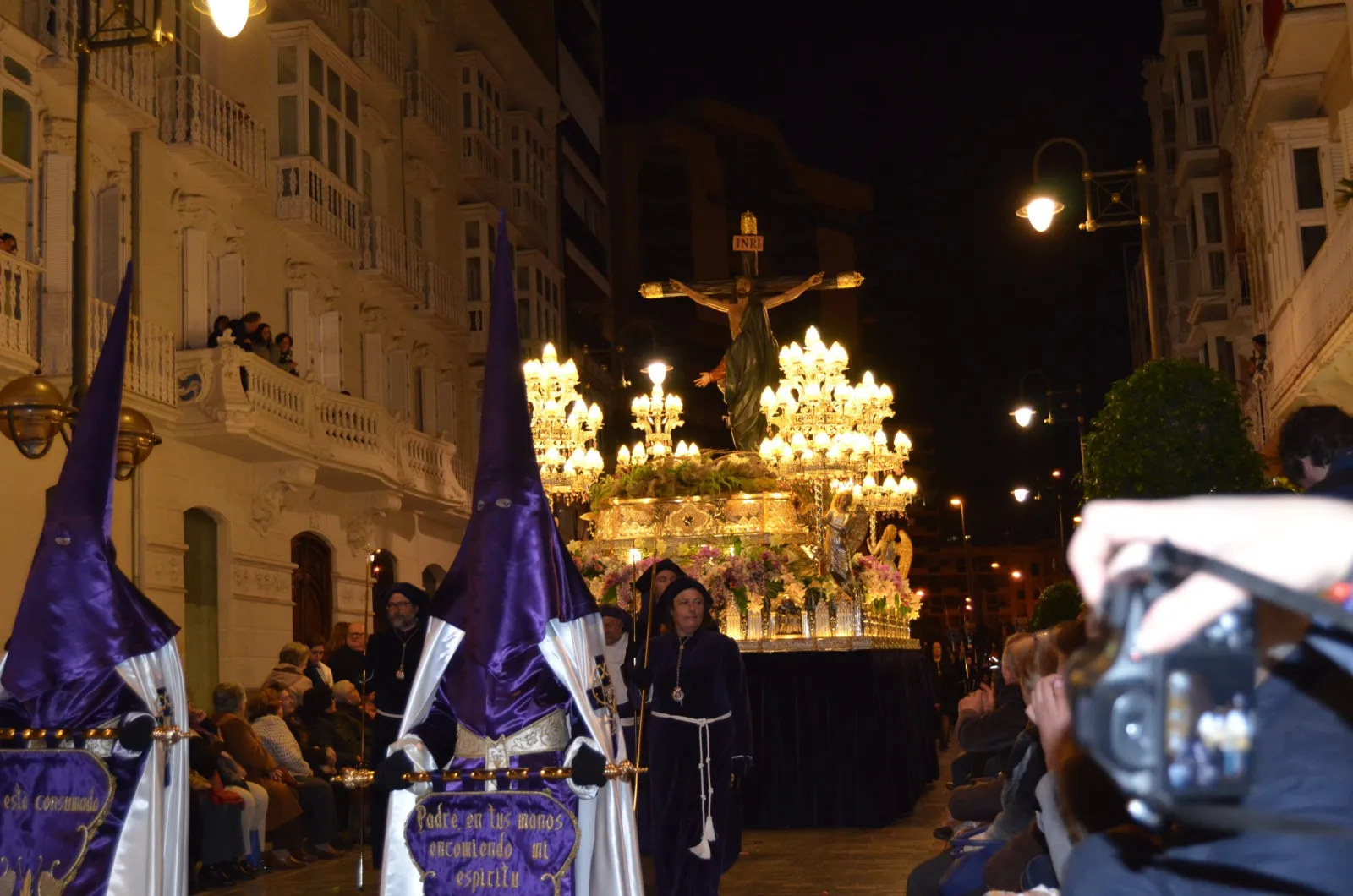
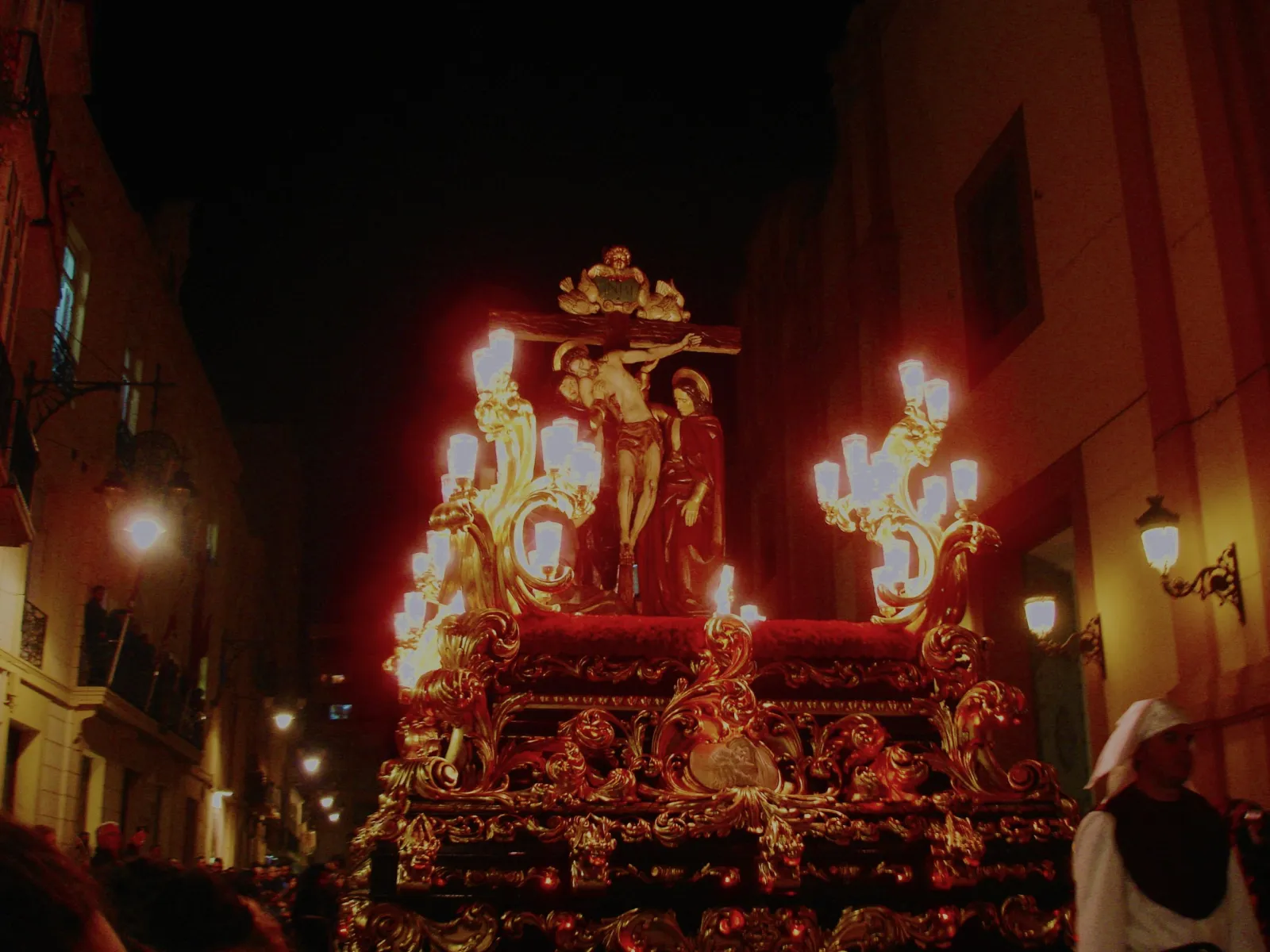
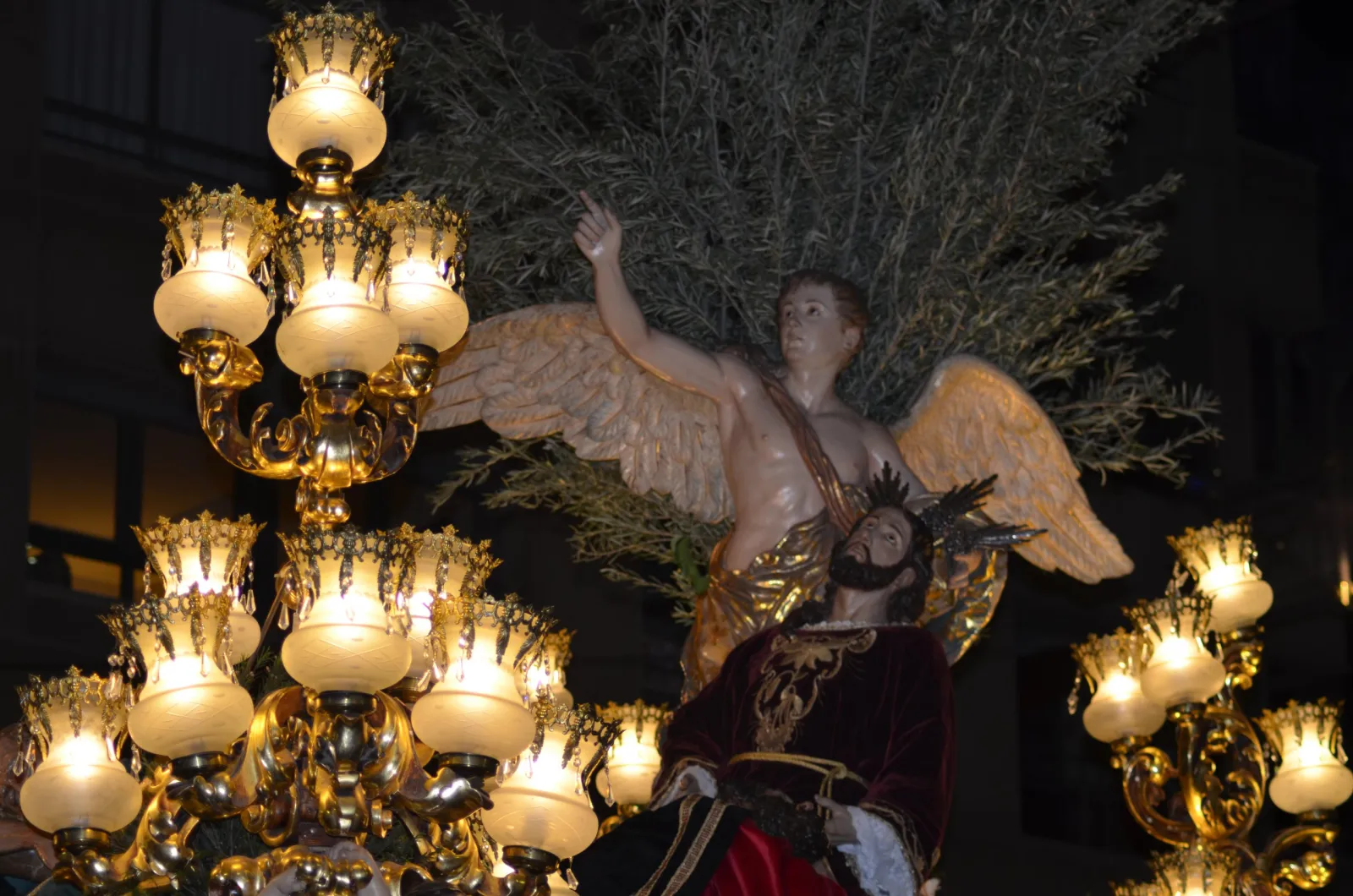
Cartagena's processions are known above all for their order. Penitents march to the beat of the drum in perfect unison, walking and stopping all at once and standing motionless during each halt, more like a parade than the swaying crowds of Andalusia. Add the flowers and light of the thrones and the big candle lanterns (hachotes), the music of the bands and a heritage of sculptures by Francisco Salzillo, José Capuz, Mariano Benlliure, Juan González Moreno and others, plus embroidered mantles and banners, some from the 18th and 19th centuries.
Every procession follows the same pattern. Nazarenos walk with their faces uncovered and are the only ones who hand out sweets, including the "sepulcros" made for Holy Week; an embroidered standard then leads each tercio, two lines of hooded penitents leaning on their hachotes, followed by its band and its throne. Granaderos recall the military pickets that escorted the Virgins in the 18th century, and in this naval city a real military picket from the Army, Navy or Marines closes the processions.
Five brotherhoods take part, each with its colour: the Socorro (black), the Misericordia, the Californios (red), the Marrajos (purple) and the Resucitados (white). The friendly rivalry between Californios and Marrajos, who split most of the week between them, is part of the city's identity: the Californios go out on the Friday of Sorrows, Palm Sunday and Holy Tuesday to Thursday, the Marrajos on Holy Monday, at dawn and at night on Good Friday, and on Holy Saturday. Almost every procession leaves from and returns to Santa María de Gracia, an 18th-century church in Calle del Aire whose façade was never finished.
Cartagena was declared a Fiesta de Interés Turístico Internacional in 2005. Most processions are at night and in the early hours, which gives them a solemn feel; the city is compact, so you can see several in one trip.
Gallery
History & Origins
The brotherhoods are old. The Marrajos (Real e Ilustre Cofradía de Nuestro Padre Jesús Nazareno) are the oldest, with roots in the early 17th century. The Cofradía del Cristo del Socorro was founded in 1691 by the Duke of Veragua, Captain General of the Galleys of Spain, and the Californios were founded on 13 June 1747; their Prendimiento procession on Holy Wednesday dates from then. The Resucitados were born in the 1940s, when a group of processionists felt Holy Week was incomplete without a Resurrection procession, and the Misericordia is the most recent addition.
The Civil War hit hard: Santa María de Gracia, the processions' home church, had to have its interior rebuilt after the events of the first days of the war in 1936. Holy Week recovered and grew, and on 25 November 2005 Spain's General Secretariat for Tourism declared it a Fiesta de Interés Turístico Internacional.
What to Expect
Expect processions that feel like a choreographed march: tercios of hooded penitents, bands, thrones carried or wheeled and lit by hundreds of lights, with every unit moving and stopping together. The atmosphere is serious but proud, and the streets of the old town fill with locals who know exactly where to stand.
The Junta de Cofradías recommends a few spots. Calle Puertas de Murcia is straight, so you can see each procession almost whole. Calle Cañón is steep and hard work for the bearers; on Easter Sunday the Virgen del Amor Hermoso is carried up it at legionnaire's pace. Calle Serreta lets you take in the full line: penitents, tercio, band and throne. Some exits are events in themselves: San Pedro leaves from the Arsenal gate in Calle Real on Holy Tuesday, Jesús Nazareno from the Lonja de Pescados de Santa Lucía at dawn on Good Friday, and Jesús de Medinaceli from the old Naval Hospital, now the Polytechnic University.
It is well worth visiting Santa María de Gracia in the hours before a procession, when the thrones are dressed, the flowers set and the hachotes prepared. At the end of the Resurrection procession, thousands sing the Salve Cartagenera.
How to Get There
Cartagena is a port city on the coast of the Region of Murcia, also a regular cruise-ship stop.
- By air: Región de Murcia International Airport (Corvera) is the closest; Alicante airport has more international routes.
- By train: Cartagena station has Renfe services from Murcia and long-distance trains from Madrid. The old town and Santa María de Gracia are walkable from the station.
- By car: motorways link Cartagena with Murcia and Alicante. Park outside the old town, where streets close for processions.
Tips & Advice
- Check times and routes on the official Holy Week website; seats along the route are sold online.
- Take your spot a good while before each procession starts, especially on Holy Wednesday and Good Friday.
- Visit Santa María de Gracia in the hours before a procession to see the thrones being prepared.
- Set an alarm for one dawn: the Socorro on Friday of Sorrows or the Encuentro on Good Friday.
- Processions run late into the night: bring a layer, as evenings by the sea can be cool in March.
- Book accommodation early: Easter 2027 falls in late March and the city fills up.
Photos: SanJuanistaMarrajo / CC BY-SA 4.0 / Wikimedia Commons; Rheo ct / CC BY-SA 4.0 / Wikimedia Commons
Semana Santa de Lorca (Biblical Parades)
Lorca, MurciaPharaohs, Roman emperors and horsemen of the Apocalypse charge down a sand-covered avenue as Lorca's Blue and White brotherhoods compete to stage the most spectacular Holy Week in Spain.
Bando de la Huerta
Murcia, MurciaOn the Tuesday after Easter the whole of Murcia dresses as market gardeners for the Bando de la Huerta, the big day of the city's Spring Festival, with a flower offering, food stalls and a parade that throws snacks to the crowd.
Entierro de la Sardina de Murcia
Murcia, MurciaMurcia's Entierro de la Sardina is one of Spain's most unique spring festivals. A surreal parade where thousands of toys are thrown from floats, giant sardine effigies are burned, and fireworks light up the night. Declared a Fiesta of International Tourist Interest.
Wine Horses of Caravaca (Fiestas de la Vera Cruz)
Caravaca de la Cruz, MurciaFrom 1 to 5 May, Caravaca de la Cruz honours its True Cross with Moors and Christians and the UNESCO-listed Wine Horses: some 60 horses in embroidered silk and gold, each racing up the castle slope with four runners clinging on.