Holy Week in Granada
Granada's Holy Week sets more than thirty brotherhoods against the backdrop of the Alhambra, the Albaicín and the caves of Sacromonte, where bonfires light the Gypsies' procession on Holy Wednesday night.
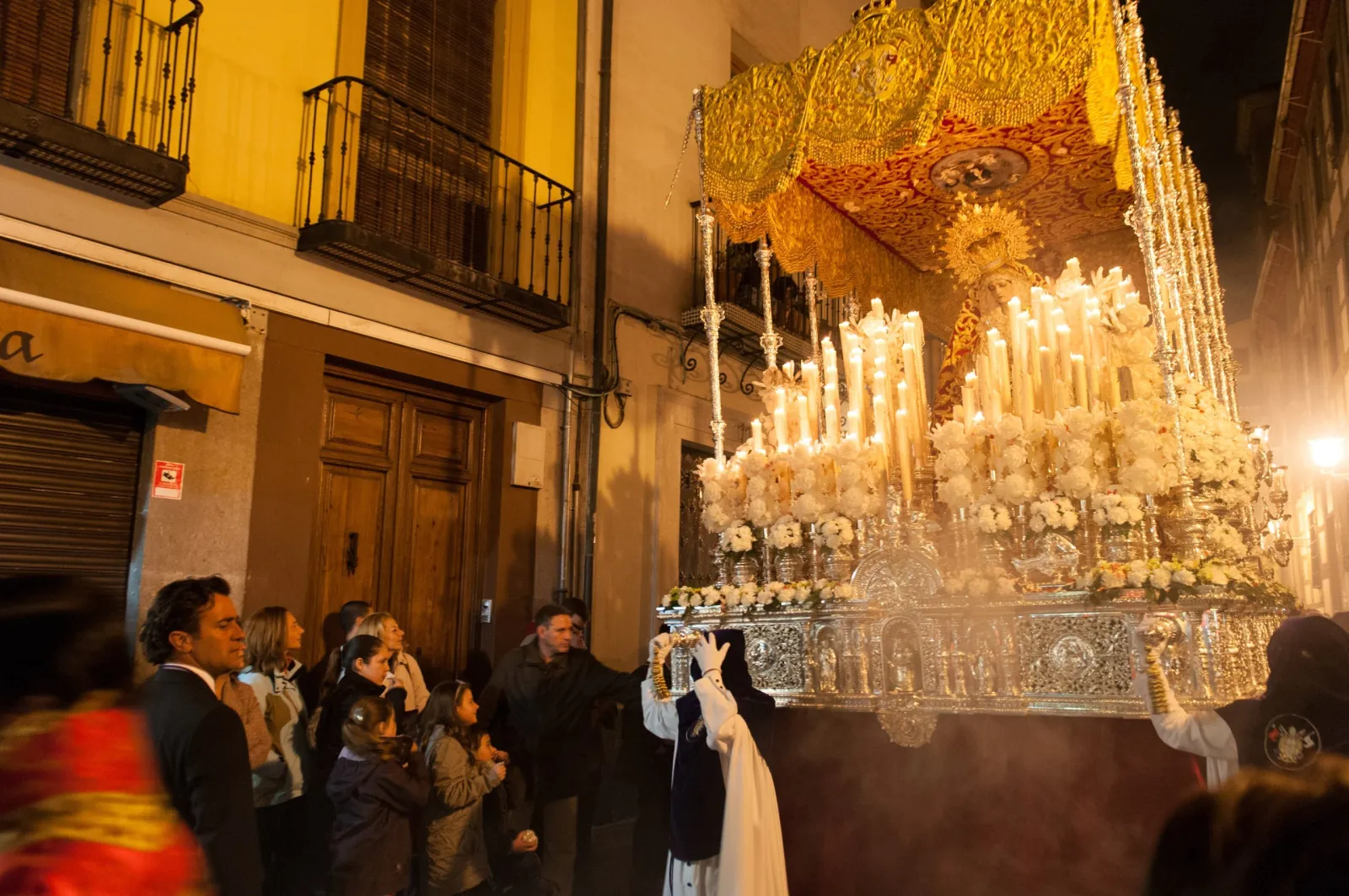
The days that matter
-
Sun 21 Mar
Palm Sunday
Holy Week opens with the first drumbeats and processions across the city.
-
Wed 24 Mar late night
Los Gitanos to Sacromonte
The Cristo del Consuelo and the Virgin of Sacromonte climb to the Abbey between cave bonfires and zambras.
-
Thu 25 Mar after midnight
Cristo del Silencio
A silent procession through the Albaicín, with only the drum; the quarter's three Virgins also go out.
-
Fri 26 Mar at dusk
Soledad de San Jerónimo
Granada's oldest brotherhood leaves San Jerónimo with living figures from the Passion.
-
Sat 27 Mar
Santa María de la Alhambra
The Alhambra's own Virgin processes on Holy Saturday.
-
Sun 28 Mar
Easter Sunday
Children carry jingling clay lanterns in the Resurrection procession.
What Holy Week in Granada is like
- Procession
- Night
- Free
- Noise
- Bands and drums, with true silence on Silencio nights
- Fire
- Bonfires on Sacromonte on Holy Wednesday; candles elsewhere
- Crowds
- Packed narrow lanes in the Albaicín and Sacromonte
- Mess
- Only candle wax on the cobbles
- With kids
- Fine in the afternoon; late nights and crowds are tiring
Highlights
- Holy Wednesday: Los Gitanos climb to Sacromonte between bonfires and zambras
- Holy Thursday: the Cristo del Silencio in the Albaicín, with only a drum to break the silence
- Good Friday dusk: the Soledad de San Jerónimo, Granada's oldest brotherhood, with living Passion figures
- Holy Saturday: Santa María de la Alhambra
- Easter Sunday: children with clay lanterns in the Resurrection procession
Semana Santa de Granada 2027: dates
Holy Week in Granada runs from Palm Sunday 21 March to Easter Sunday 28 March 2027. Processions take place every day, mostly from the afternoon into the small hours. Each brotherhood publishes its own route and timetable shortly before Holy Week, so check the official programme once it is out.
Processions with the Alhambra as backdrop
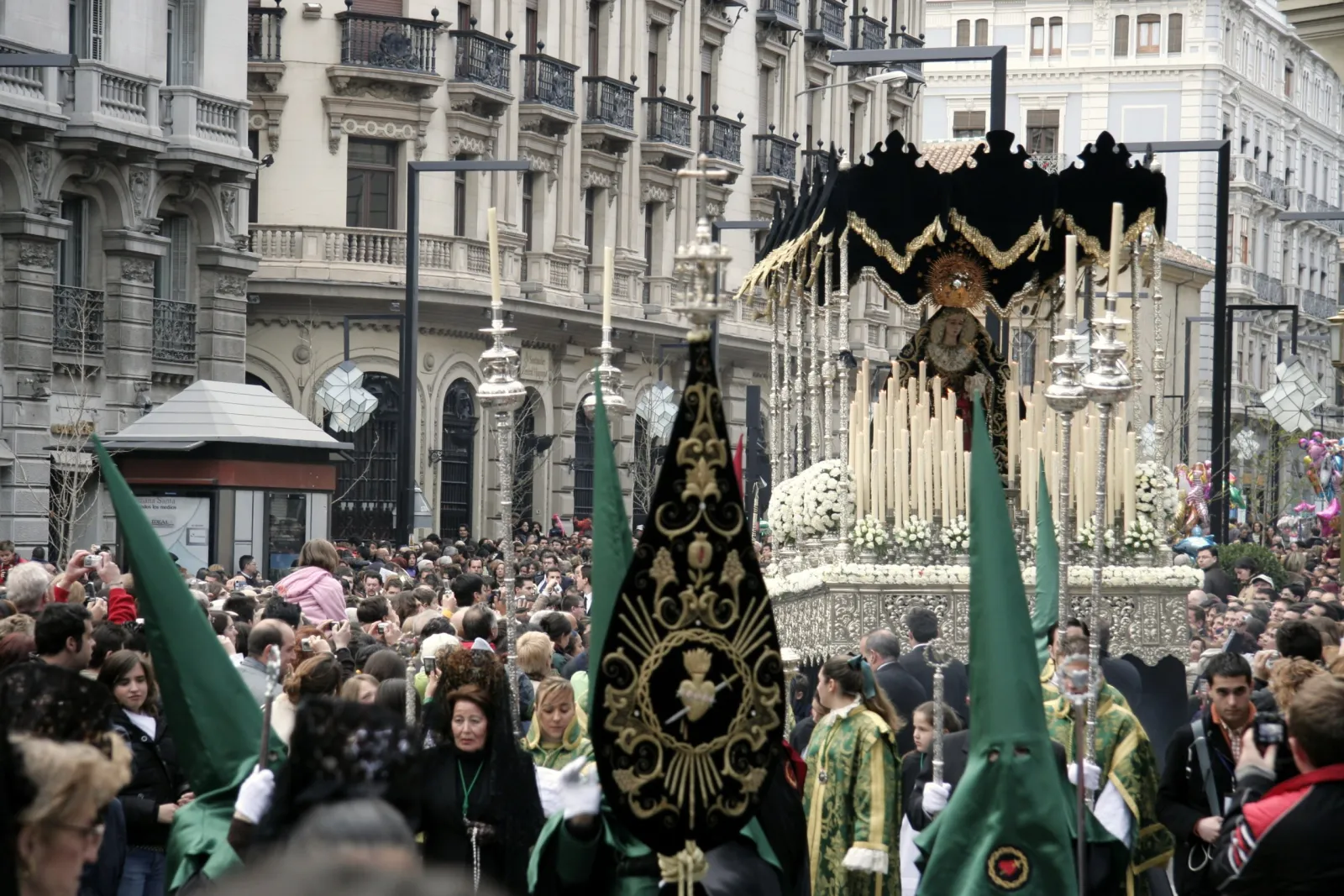
Granada's Holy Week is a Festival of International Tourist Interest (since 2009), and Spain's official tourism portal counts 32 brotherhoods taking part, which between them put 34 processions on the street. The Real Federación de Hermandades y Cofradías, founded in 1927, coordinates them with the Archdiocese. What makes Granada different from other Andalusian cities is the setting: steep, narrow lanes of the Albaicín, the cave houses of Sacromonte and the walls of the Alhambra on the hill above.
From the barrios to the centre
The first days belong to the neighbourhoods. On Palm Sunday children dressed in Hebrew costume walk with palms beside La Borriquilla from the church of San Andrés. On Holy Monday the Hermandad del Trabajo leaves the Zaidín district with one of the longest corteges of the week, and Jesús del Rescate, carved by Diego de Mora in 1718, draws one of the city's deepest devotions. On Holy Tuesday the Vía Crucis brotherhood, the senior member of the Federation, prays the fourteen Stations of the Cross on its way back from Plaza Nueva.
Sacromonte, the Albaicín and the Alhambra
The best-known night is Holy Wednesday. The brotherhood known as Los Gitanos, which first processed in 1940, carries the Cristo del Consuelo and María Santísima del Sacromonte through the city and up to the Abbey of Sacromonte. Along the way, large bonfires are lit among the caves and homes of the Gypsy quarter, and zambra singing and dancing break out as the images pass.
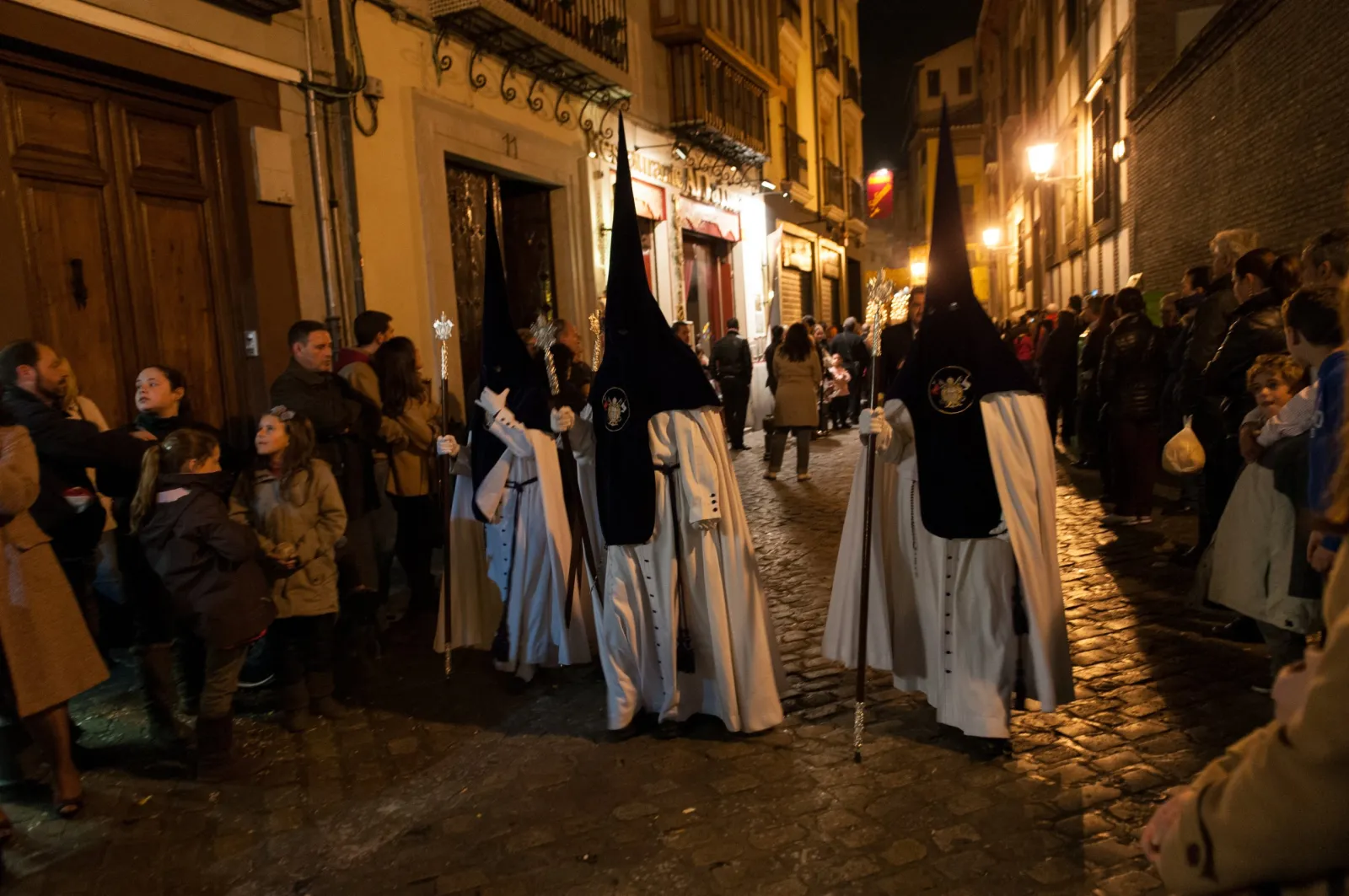
On Holy Thursday the Cristo del Silencio, a 17th-century crucifix by José de Mora, crosses the Albaicín with only the beat of a drum and a silent crowd; the neighbourhood's three Virgins, la Concha, la Estrella and la Aurora, also process, and the quarter is at its most atmospheric after midnight. At dusk on Good Friday the oldest brotherhood, the Soledad de San Jerónimo, founded in 1561, leaves the Monastery of San Jerónimo. It is known as Las Chías after the figures that head it, dressed as officials of the old Inquisition with plumes and embroidery, to the sound of fanfares and kettledrums; Roman soldiers strike the ground with their lances, and living figures play the three Marys, Nicodemus and Joseph of Arimathea. On Holy Saturday, Andalusia's tourism board suggests following Santa María de la Alhambra, whose Virgen de las Angustias, a Pietà by Torcuato Ruiz del Peral, sets out from the church inside the Alhambra walls. On Easter Sunday children carry jingling clay lanterns, the facundillos, in the Resurrection processions.
Gallery
History & Origins
Holy Week processions in Granada have centuries of history, and the city's oldest brotherhood, the Soledad de San Jerónimo, still parades on Good Friday evening with figures that recall the old processional customs. The Gypsy community of Sacromonte has its own brotherhood, whose Holy Wednesday pilgrimage back to the Abbey has become one of the defining images of Granada.
In 2009 Spain's Secretary of State for Tourism granted Granada's Semana Santa the title of Festival of International Tourist Interest (BOE, 2 November 2009).
What to Expect
Expect long evenings on your feet. The pasos (floats) move slowly, carried by bearers, and the official route through the city centre fills up early, while the processions in the Albaicín and Sacromonte squeeze through lanes so narrow that the crowd moves with them. The atmosphere switches between solemn silence and bursts of music from the bands.
Holy Wednesday on the Sacromonte slopes is the most crowded and the most memorable: the procession reaches the Gypsy quarter late at night and the climb to the Abbey continues into the early hours. Late March nights in Granada can be chilly, and rain can cancel a procession at the last minute.
How to Get There
Train: high-speed AVE trains run to Granada station from Madrid and other Spanish cities.
Air: Federico García Lorca Granada-Jaén Airport has domestic and some European flights; Málaga Airport is the larger alternative, with buses to Granada.
In the city, the Albaicín and Sacromonte are best reached on foot or by the small city buses; traffic is restricted on procession days.
Tips & Advice
- Book a room months ahead: Holy Week is one of the busiest weeks of the year in Granada.
- For Holy Wednesday, pick a spot on the Sacromonte route well before the Gypsies arrive and wear shoes for steep cobbles.
- Book Alhambra tickets separately and early; they sell out in Holy Week.
- Keep silence during the Silencio processions and never cut through a cortege.
- Check Andalusia's official tourism page and the brotherhoods' timetables before heading out.
Photos: Michal Osmenda / CC BY 2.0 / Wikimedia Commons; Erik Albers / CC0 / Wikimedia Commons
Semana Santa
Seville, AndalusiaSemana Santa (Holy Week) is arguably Spain's most emotionally powerful and visually stunning festival. In the week leading up to Easter Sunday, cities and towns across the country fill with solemn religious processions, haunting music, clouds of incense, and enormous ornate floats (pasos) carried by hundreds of robed nazarenos.
Semana Santa de Málaga
Málaga, AndalusiaMálaga's Semana Santa is one of Spain's most emotional and spectacular Holy Week celebrations. Famous for its massive tronos (processional thrones) carried by hundreds of bearers, the spontaneous singing of saetas, and the unique tradition of releasing a prisoner, it draws over a million visitors every spring.
Semana Santa de Córdoba
Córdoba, AndalusiaSince 2017 every brotherhood in Córdoba makes its station of penance inside the Mezquita-Catedral, giving the city one of the most striking backdrops of any Holy Week in Andalusia.
Romería del Rocío
El Rocío, AndalusiaThe Romería del Rocío is one of the most extraordinary religious and cultural events in the world — a mass pilgrimage to the shrine of the Virgen del Rocío (the White Dove) in the village of El Rocío, on the edge of the Doñana National Park in Huelva, Andalusia.