Diada de Sant Jordi
On April 23rd, Catalonia celebrates its most romantic tradition. Streets fill with stalls selling books and roses as couples exchange gifts: a rose for her, a book for him.
Highlights
Blends the medieval legend of Sant Jordi and the dragon with a modern love of books
Book and rose stalls line La Rambla, Passeig de Gracia, and Rambla de Catalunya
Authors and illustrators sign books at small tables across the city
Recognised by UNESCO in 1995 as International Book Day
On 23 April, Catalonia celebrates Sant Jordi (Saint George), its patron saint, with a tradition unlike any other festival in Spain: streets across every town and city fill with stalls selling roses and books, and couples exchange a rose for her and a book for him. The custom blends the medieval legend of the knight who slew a dragon to save a princess — a rose said to have bloomed from the dragon's spilled blood — with a 20th-century book trade tradition begun by Barcelona booksellers in the 1920s. The date carries extra weight internationally: it also marks the deaths of both Miguel de Cervantes and William Shakespeare in 1616, which is why UNESCO chose 23 April as World Book Day in 1995, taking Sant Jordi's book-giving custom as its model. In Barcelona, La Rambla and Passeig de Gràcia fill with rose and book stalls from morning to night, publishers hold their biggest sales day of the year, and authors sign books at stands across the city.
History & Origins
The Diada de Sant Jordi, celebrated every April 23rd in Catalonia, blends two once-separate traditions: a medieval legend of Saint George and a modern celebration of books. According to legend, Sant Jordi slew a dragon to save a princess, and from the dragon's blood grew a rose bush, from which the knight picked a rose to give to the princess in return; the saint was named patron of Catalonia in 1456, and the custom of giving roses on his feast day dates back centuries. Separately, in 1923 the Valencian writer and publisher Vicente Clavel proposed a national day dedicated to books, originally set for October 7th. It was moved in 1931 to April 23rd at the request of booksellers, both to coincide with the anniversaries of the deaths of Cervantes and Shakespeare and because the date already carried the popular weight of the Sant Jordi rose festival. The custom was suppressed under the Franco dictatorship along with much of Catalan culture, then re-emerged strongly after Spain's return to democracy. In 1995 UNESCO adopted April 23rd as International Book Day, permanently linking the Catalan tradition to a global celebration of reading.
What to Expect
On Sant Jordi, Barcelona's streets, especially La Rambla, Passeig de Gracia, and Rambla de Catalunya, fill with stalls selling books and red roses, staffed by publishers, bookshops, schools, and independent authors and illustrators, many of whom sign copies of their own books at small tables set up along the pavement. The official slogan since 1997, "a rose for love, a book forever," captures the day's exchange: it is traditional to give a rose to a loved one and receive a book in return. Bookshops see some of their busiest trading of the year, with queues extending out onto the street, and the day generates a significant share of Catalonia's annual book sales alongside the sale of several million roses. In recent years, Barcelona's city council and the regional booksellers' guild have introduced a pedestrianised "literary superblock" around Passeig de Gracia to manage crowds and keep the area focused on publishing professionals.
How to Get There
Barcelona is served by El Prat international airport, with excellent connections across Europe and beyond, as well as a dense network of high-speed and regional trains linking it to Madrid, Girona, and the wider region. Within the city, the metro and bus network reach all of the main Sant Jordi locations; La Rambla, Passeig de Gracia, and Rambla de Catalunya are all served by nearby metro stations and are within walking distance of each other in the city centre.
Tips & Advice
Expect the central streets to be extremely crowded throughout the day, so allow extra time to move between stalls and be prepared for a slow, festive pace rather than efficient sightseeing. If you want to visit a particular author's signing session, check bookshop schedules in advance, since popular writers draw long queues. Bring cash, as many of the temporary street stalls are not set up for card payments. Since the day falls in late April, weather can be changeable, so a light jacket is a sensible addition even on a sunny forecast.
Plan Your Trip
Book accommodation and transport for this festival. Get the best deals on hotels and train tickets.
This page contains affiliate links. We may earn a commission at no extra cost to you.
 September
La Mercè
La Mercè (officially Festa Major de Barcelona) is Barcelona's largest annual festival, celebrating the city's patron saint, Our Lady of Mercy. Held every year around 24 September, it transforms the city into a four-day programme of over 600 free events — world-class concerts, traditional Catalan folk displays, fire runs, human towers, and open-air parties across every neighbourhood.
 December
Medieval Market of Vic
The Mercat Medieval de Vic is Catalonia's premier medieval event and one of the largest medieval markets in southern Europe. Every December, the elegant market town of Vic transforms its historic centre into a medieval world with over 500 stalls, theatrical performances, workshops and tens of thousands of visitors. Combined with the atmospheric winter setting and Vic's rich architectural heritage, it's a unique pre-Christmas medieval experience.
 September
Diada de Catalunya
Catalonia's National Day on September 11th commemorates the fall of Barcelona in 1714 with massive demonstrations, cultural events, castells (human towers) and sardana dancing.
 September
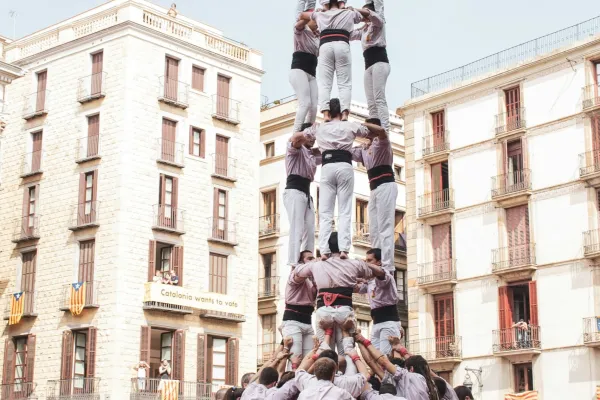
Castells Festival Season (Catalonia)
The castells season in Catalonia runs mainly from spring to autumn, when local teams (colles castelleres) build human towers during festivals in towns across the region.