Holy Week in Toledo
Toledo's Holy Week is known for its sobriety: some twenty brotherhoods carry their images through the narrow lanes of the UNESCO-listed old town, often late at night and in near silence.
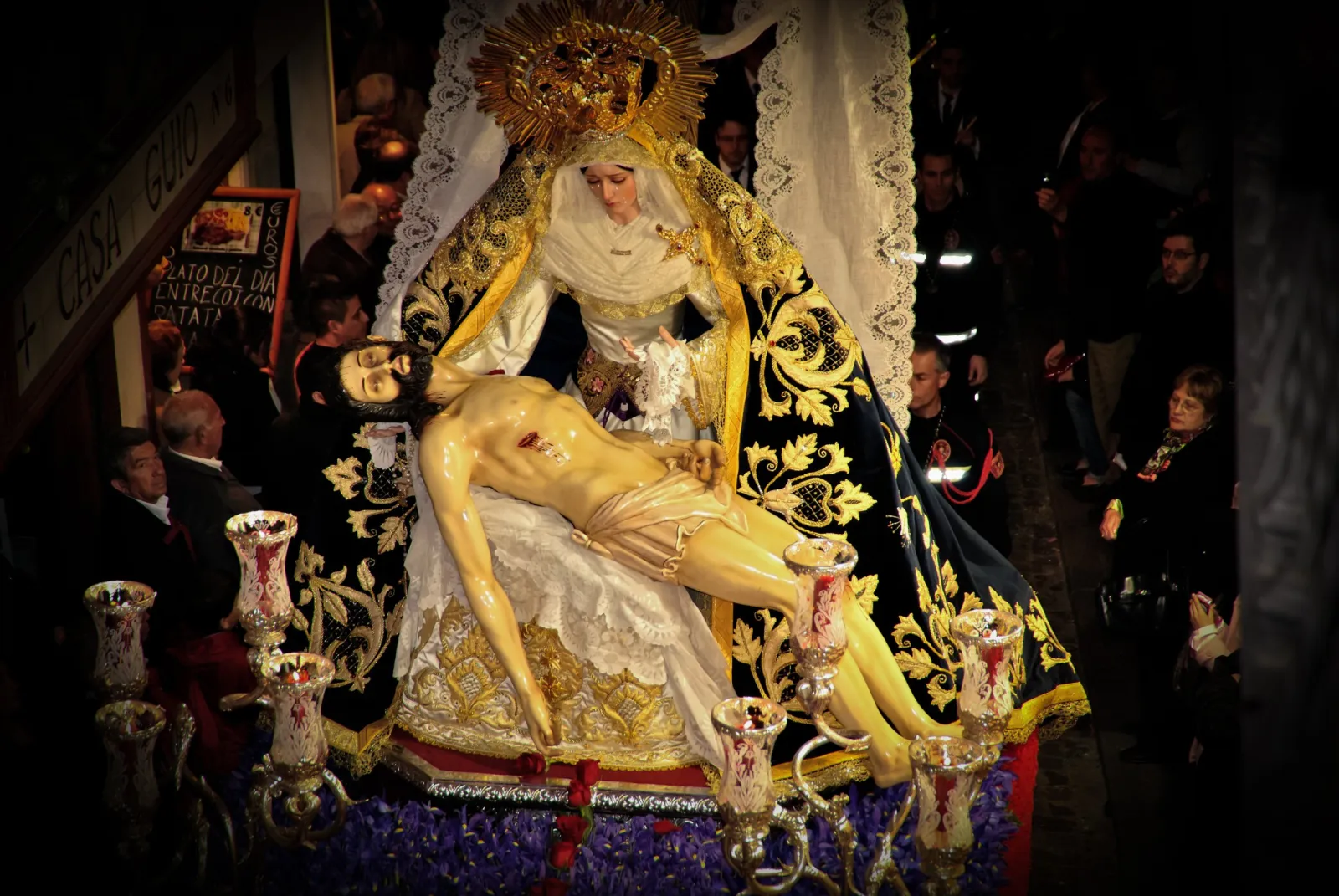
The days that matter
-
Sun 21 Mar 18:00 (2025 times)
La Borriquita
Palm Sunday procession from the Mozárabe parish of Santas Justa y Rufina through Zocodover.
-
Wed 24 Mar 21:00 and 23:30 (2025 times)
Humildad and Cristo Redentor
The Cristo de la Humildad leaves San Juan de los Reyes; later the Caballeros Penitentes leave Santo Domingo el Real.
-
Fri 26 Mar midnight
Cristo de la Vega
From the Cathedral out through the Puerta del Cambrón and down to the Basilica of the Cristo de la Vega.
-
Fri 26 Mar 03:00 (2025 times)
Cristo de la Expiración
A pre-dawn procession from the monastery of Santo Domingo de Silos (El Antiguo).
-
Fri 26 Mar 20:30 (2025 times)
Santo Entierro
The main Good Friday procession, joined on the way by the Calvario, Misericordia and Mozárabe brotherhoods.
-
Sun 28 Mar 11:00 (2025 times)
El Encuentro
The Risen Christ meets the Virgen de la Alegría in Plaza del Ayuntamiento, followed by the Archbishop's blessing.
What Holy Week in Toledo is like
- Procession
- Night
- Free
- Noise
- Drums and bands at times, but mostly hushed
- Crowds
- Narrow lanes fill fast on corners and squares
- Mess
- Just candle wax and steep cobbles
- With kids
- Afternoon processions suit families; late nights are long
Highlights
- The Cristo de la Vega leaving the Cathedral at midnight and walking down to its basilica by the river
- The Cristo de la Expiración at 3:00 on Good Friday, in silence except for the horquillas on the cobbles
- The Santo Entierro on Good Friday evening, joined by several brotherhoods and the Mozárabe knights
- The Santo Encuentro at the Puerta de Bisagra on the Saturday before Palm Sunday
- Pasos squeezing through the tight corners of the old town
- The Easter Sunday Encuentro in front of the Cathedral
Semana Santa de Toledo 2027: dates
Holy Week in Toledo runs from Palm Sunday 21 March to Easter Sunday 28 March 2027, with the first processions already on the Friday of Sorrows (19 March) and the Saturday before Palm Sunday. The Junta de Cofradías, Hermandades y Capítulos publishes the routes and times for each day on semanasantatoledo.com, usually in February; the times mentioned below come from the latest programme on its website and tend to change little from one year to the next.
Silent streets in an imperial city
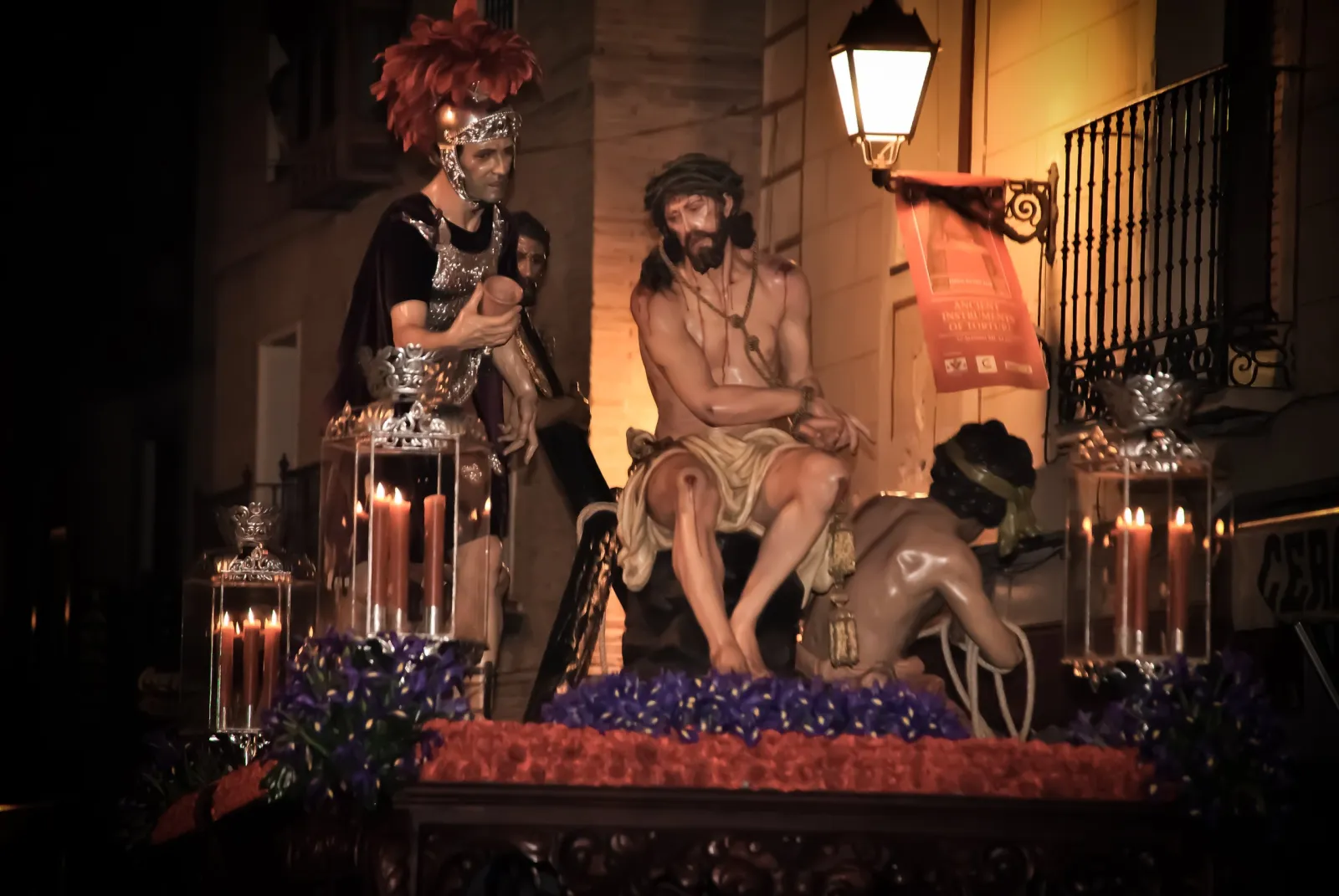
Toledo's Semana Santa is a Festival of International Tourist Interest (since 2014). Spain's official tourism portal stresses its sobriety, and much of its charm comes from the setting: around twenty brotherhoods, chapters and confraternities carry more than thirty pasos through the steep, winding lanes of the old town, where the bearers have to manoeuvre them round tight corners. Churches, convents and monasteries that are normally closed open their doors for the services, and at several stops seminarians sing motets and the Miserere.
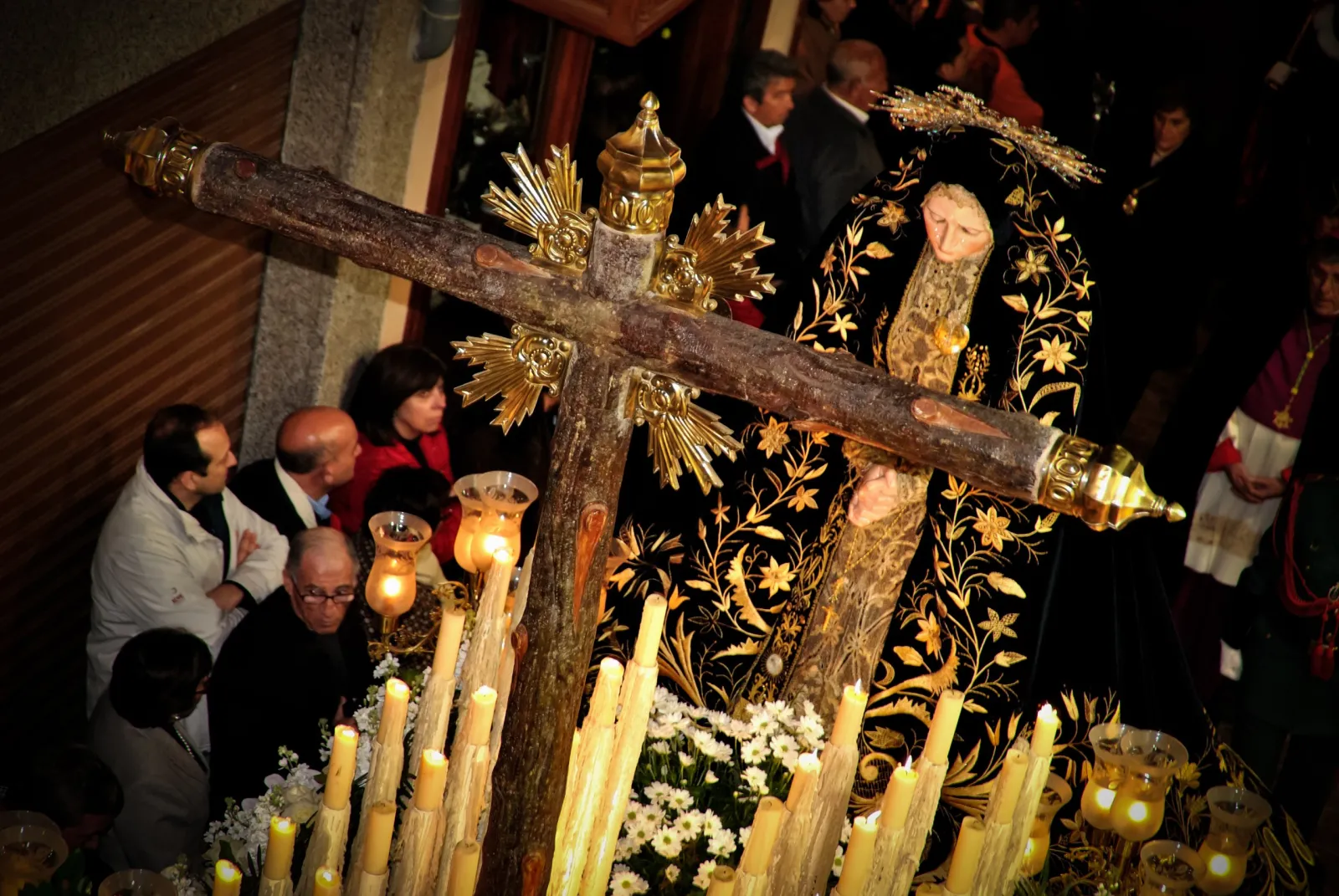
Highlights include La Borriquita on Palm Sunday afternoon; on Holy Wednesday night the Cristo de la Humildad leaves the monastery of San Juan de los Reyes and the Caballeros Penitentes de Cristo Redentor set off late from Santo Domingo el Real. In the first minutes of Good Friday, the Cristo de la Vega leaves the Cathedral and walks out through the Puerta del Cambrón and down the Bajada de la Cava to its basilica by the river. Its right arm hangs down from the cross, the subject of a legend that José Zorrilla retold in his poem A buen juez, mejor testigo. At 3:00 the Cristo de la Expiración follows from Santo Domingo de Silos (El Antiguo).
On Good Friday evening the Santo Entierro leaves the Mozárabe parish of Santas Justa y Rufina, joined along the way by the Calvario, the Misericordia and the Mozárabe knights and ladies. On Easter Sunday morning, the Risen Christ and the Virgen de la Alegría meet in Plaza del Ayuntamiento, in front of the Cathedral, where the Archbishop blesses the crowd.
Knights, lanterns and silence
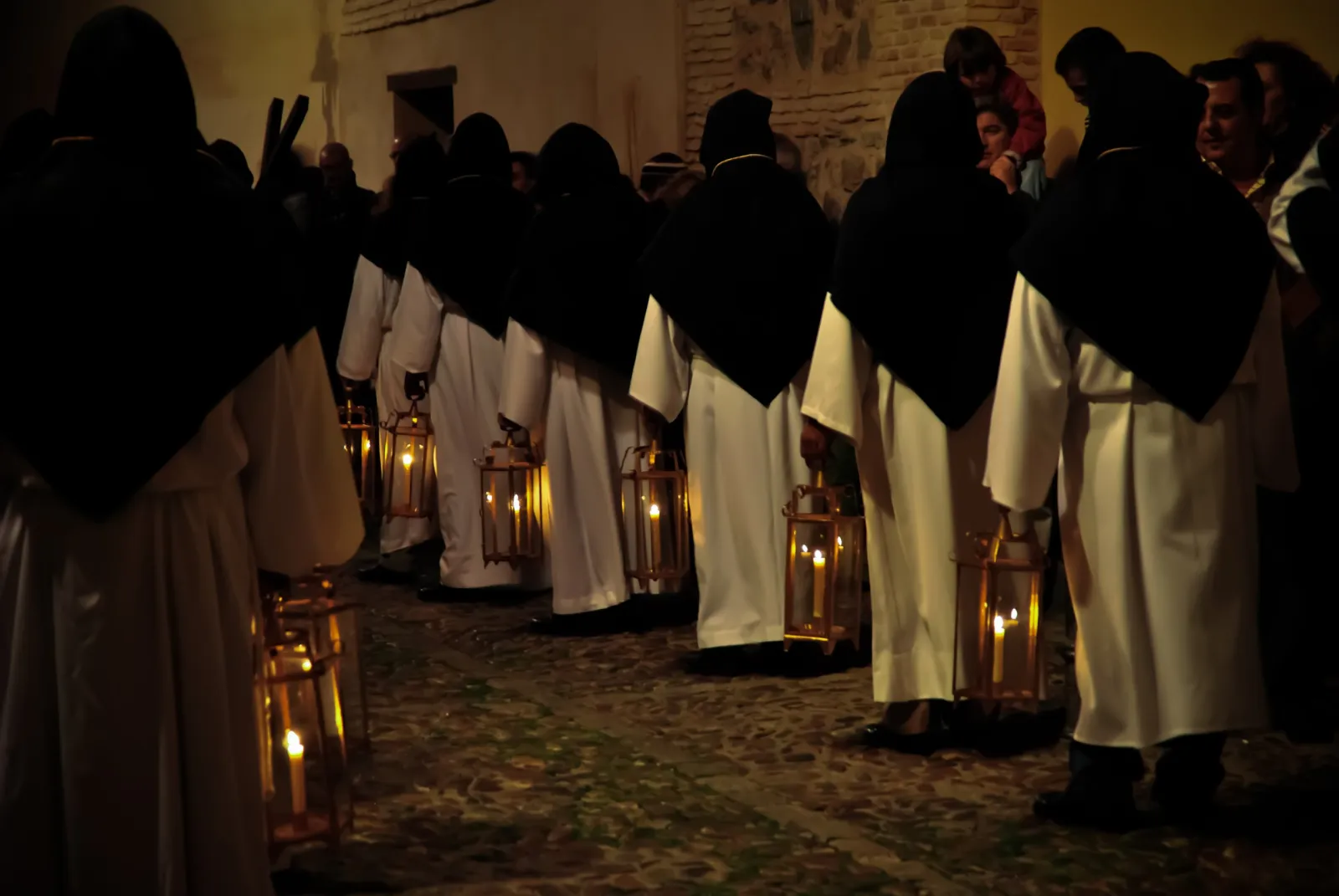
Part of Toledo's character comes from its chapters of knights. The Mozárabe knights and ladies, whose brotherhood traces its origins to 1513, wear dark blue capes with the cross of Alfonso VI and carry a Lignum Crucis under a canopy; the Caballeros del Santo Sepulcro wear ivory capes with the red Jerusalem cross. On Holy Tuesday the Santa Caridad, which tradition says Alfonso VI founded in 1085, walks in black habits with lanterns on poles. The pre-dawn Expiración has no music at all: the only sound is the bearers' forked poles, the horquillas, striking the cobbles. In the small hours of Holy Saturday the Cristo de la Buena Muerte prays a fourteen-station Via Crucis through the old town, starting and ending at San Juan de los Reyes.
2027: the Cathedral's jubilee year
The 2027 edition falls in a special year for the Cathedral, which is marking eight centuries since work on it began. Its Jubilee Year opened on 25 October 2026, and the president of the Junta de Cofradías has said it will close with the 5th National Congress of Holy Week in World Heritage Cities, which Toledo hosts in 2027. Several brotherhoods normally leave from or return to the Cathedral through the Puerta Llana; in 2026 that was not possible because the centenary exhibition Primada filled the building, and routes had to change. The exhibition closed in October 2026, so check the 2027 programme to see whether the usual Cathedral routes return.
Gallery
History & Origins
Toledo's Holy Week has documented roots in the 16th century, after the Council of Trent, and several of its brotherhoods claim even older origins: tradition credits Alfonso VI with founding the Santa Caridad in 1085, the Mozárabe brotherhood traces itself to 1513, the brotherhood of the Cristo de la Vega is documented from 1668, and the Esclavitud de Nuestro Padre Jesús Nazareno, which stages the Santo Encuentro at the Puerta de Bisagra, was founded in 1731. In the 17th and 18th centuries the brotherhoods commissioned images from local workshops and, in some cases, from Andalusian sculptors. In 1869 the poet Gustavo Adolfo Bécquer wrote in El Museo Universal about the contrast between Toledo's austere Castilian Holy Week and the splendour of Seville's.
For centuries the brotherhoods kept their traditions alive on their own. Until 1989 the heads of several brotherhoods simply met to coordinate the order of the processions; that year, at the suggestion of Cardinal Marcelo González, they formed the Junta de Cofradías, formally constituted by decree on 25 November 1989. The Junta united the images of several brotherhoods into a single Good Friday procession through the main streets, which helped make that day one of the most visited of the year.
Later milestones include the founding in 2001 of the brotherhood of the Cristo de los Ángeles, which processes on Holy Tuesday. Toledo's Holy Week was declared of National Tourist Interest in 2006, and in 2014 Spain's Secretary of State for Tourism declared it a Festival of International Tourist Interest (BOE, 14 March 2014).
What to Expect
This is a quiet, contemplative Holy Week rather than a festive one. Processions move slowly through lanes that are often only a few metres wide, so the best views are on corners and small squares, and you will usually need to arrive well before the cortege. Night processions are the most atmospheric, with candlelight on stone walls and, at times, almost total silence.
Each brotherhood has its own sound and dress. Some walk behind brass bands or drums and cornets, the Cristo Redentor knights mark their prayers with a drum and a bell, and the Expiración goes out with no music at all. Look out for the different habits and capes, from the purple capes of the Cautivo to the garnet tunics and white hoods of the Cristo de la Vega. Seminarians sing the Miserere at several stops, and the crowd falls silent around them.
The old town sits on a hill and is full of slopes and steps, so comfortable shoes matter. The Junta de Cofradías offers chair rental along the routes. Late March nights are cool in Toledo, especially in the early hours of Good Friday, and rain can cancel or shorten a procession at short notice.
How to Get There
Train: high-speed Avant trains connect Madrid Puerta de Atocha with Toledo station in about half an hour, making Toledo an easy trip from Madrid. City buses link the station with Plaza de Zocodover; on foot it is a steep walk of around 20 minutes.
Bus: regular coaches run from Madrid's Plaza Elíptica interchange to Toledo bus station, below the old town.
Car: Toledo is about 70 km south of Madrid via the A-42 or AP-41. Parking inside the old town is very limited and many streets close for the processions; use the car parks at its edge and the public escalators up to the centre.
Tips & Advice
- If you only have one night, choose the early hours of Good Friday: the Cristo de la Vega at midnight and the Expiración at 3:00.
- Stay overnight in Toledo if you want to see the late processions; the last trains to Madrid leave long before they end.
- Arrive a day early for the Santo Encuentro at the Puerta de Bisagra on the Saturday before Palm Sunday, one of the most local moments of the week.
- Check the final 2027 routes and times on the Junta de Cofradías website, especially for processions that start or end at the Cathedral.
- Rent a chair from the Junta if you plan to watch the long Good Friday evening procession.
- Keep silence, switch off your flash and never cross through a procession.
Photos: Francisco Javier Martín Fernández / CC BY 2.0 / Wikimedia Commons
Holy Week in Cuenca
Cuenca, Castilla-La ManchaIn Cuenca the whole cliff-top old town becomes the Via Dolorosa, with one procession a day telling the Passion in order, and the drums and bugles of the Turbas announcing Good Friday at dawn.
Corpus Christi de Toledo
Toledo, Castilla-La ManchaToledo's Corpus Christi is Spain's most spectacular religious procession. Medieval streets are covered with awnings and aromatic herbs as the golden Custodia de Arfe — a 16th-century masterpiece standing 3 metres tall — processes through the ancient capital.
Feria de Albacete
Albacete, Castilla-La ManchaEleven days and nights of fair in honour of the Virgen de los Llanos, centred on Albacete's unique pan-shaped fairground and its famous iron gate.
Medieval Festival of Sigüenza
Sigüenza, Castilla-La ManchaThe Jornadas Medievales de Sigüenza transform this magnificent castle town into a living medieval spectacle every July. With jousting tournaments beneath the imposing castle-parador, a sprawling artisan market, theatrical battles, medieval banquets and hundreds of costumed participants, Sigüenza offers one of Spain's most authentic and atmospheric medieval experiences. Declared a Festival of Regional Tourist Interest.