Holy Week in Cuenca
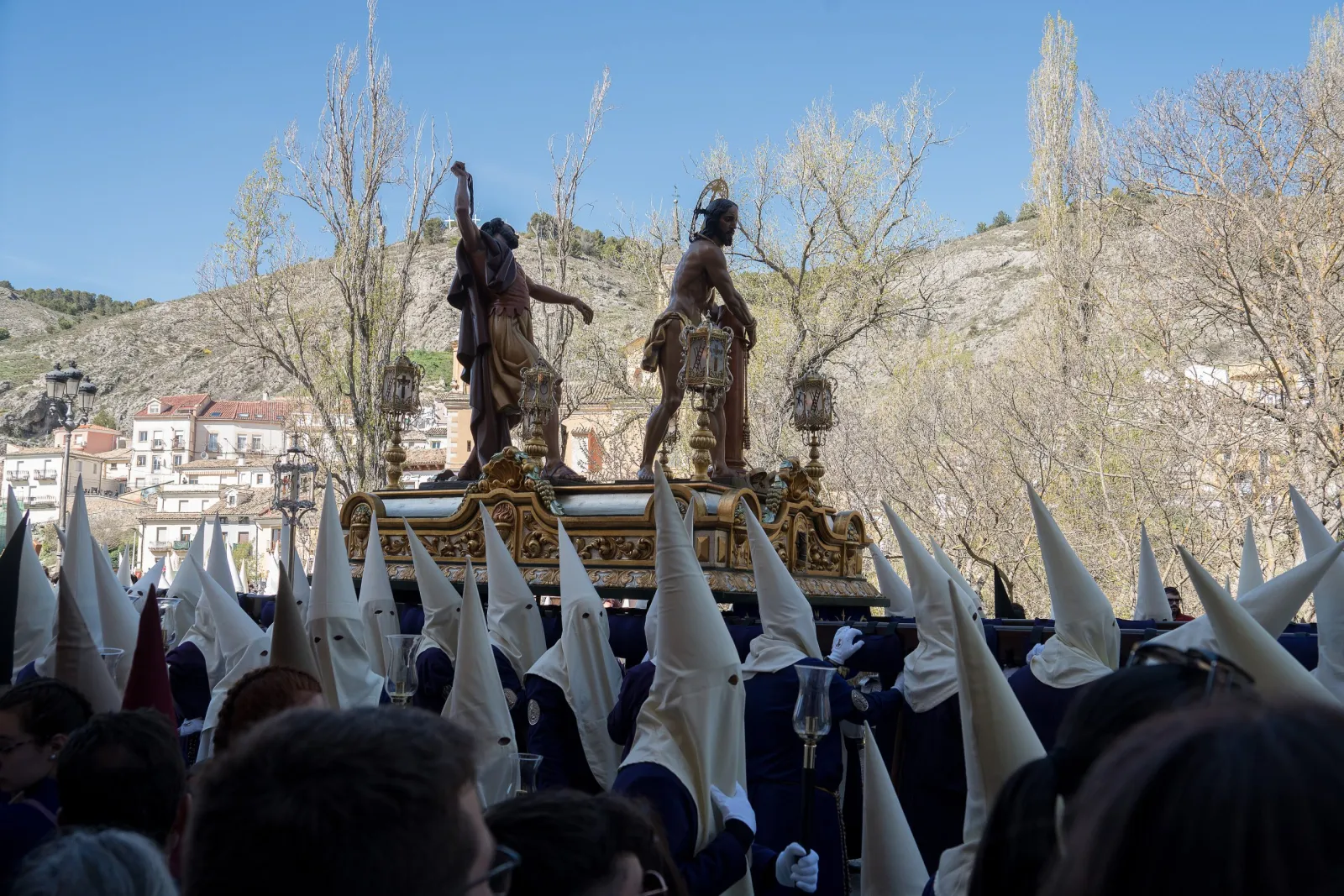
In Cuenca the whole cliff-top old town becomes the Via Dolorosa, with one procession a day telling the Passion in order, and the drums and bugles of the Turbas announcing Good Friday at dawn.
The days that matter
-
Fri 19 Mar
Proclamation
On Friday of Sorrows the Holy Week proclamation is read in the church of San Miguel, open to everyone.
-
Mon 22 Mar
Vera Cruz
A medieval-feeling night procession with the Seven Words sermon and Gregorian psalms by candlelight.
-
Wed 24 Mar
El Silencio
From the Last Supper to Gethsemane and the house of Caiaphas, entering the night.
-
Fri 26 Mar before dawn
Camino del Calvario
The Nazarenes' dawn procession, with the drums and bugles of the Turbas ahead of the Nazareno de El Salvador.
-
Fri 26 Mar at nightfall
Santo Entierro
As darkness falls, the noisy dawn gives way to total silence around the recumbent Christ.
-
Sat 27 Mar 19:00
Duelo
Our Lady of Sorrows, with Mary Magdalene and Mary Salome, goes from San Esteban to Plaza Mayor.
-
Sun 28 Mar
El Encuentro
Easter Sunday ends the week with the joyful meeting of the Risen Christ and his Mother.
What Holy Week in Cuenca is like
- Procession
- Loud
- Night
- Noise
- Drums and bugles of the Turbas at dawn on Good Friday
- Crowds
- Very busy on Thursday night and Good Friday dawn
- Mess
- You stay clean; steep cobbles are the challenge
- With kids
- Daytime processions are fine; the Turbas can overwhelm
Highlights
- Camino del Calvario at dawn on Good Friday, with the drums and bugles of the Turbas
- The Vera Cruz on Monday night, with the Seven Words preached at seven churches and Gregorian psalms
- The Hosanna on Palm Sunday morning, with petals falling from the balconies
- Pasos squeezing through Calle del Peso and under the town hall arches into Plaza Mayor
- The silent Santo Entierro on Good Friday night
- Lent food: potaje, torrijas, the honey-and-nut sweet alajú and resolí liqueur
Semana Santa de Cuenca 2027: dates
Holy Week in Cuenca runs from Palm Sunday 21 March to Easter Sunday 28 March 2027. The build-up starts on the Friday of Sorrows (19 March) with the official proclamation in the church of San Miguel. The Junta de Cofradías has already named the journalist Berta López as 2027 proclaimer and the photographer Julio Palencia as poster artist; routes and times appear on juntacofradiascuenca.es closer to the date.
The Passion, one day at a time
Cuenca's Holy Week has been a Festival of International Tourist Interest since 1980, in a city that is also a UNESCO World Heritage Site. More than thirty brotherhoods take part, and its particular trait is that the processions tell the story of the Passion in order, day by day: the Hosanna on Palm Sunday; the Vera Cruz on Monday night, with the Seven Words sermon and Gregorian psalms; El Perdón on Tuesday, beginning with the Baptism by the river Júcar; El Silencio on Wednesday, from the Last Supper to Gethsemane; and Paz y Caridad on Thursday, with Pilate and the Via Dolorosa.
The week opens at 9:30 on Palm Sunday at the old church of San Andrés, where the first drum roll of the Junta's own band is heard. The Hosanna crosses the lower town, where petals rain down from the balconies, and climbs to San Felipe Neri for the blessing of the palms. On Holy Monday the Cristo de la Vera Cruz leaves the Cathedral at 21:30 in the silence of Plaza Mayor, and the Seven Words are preached at seven churches along the way to San Esteban. El Perdón has its own anniversary to mark: the Esclavitud de Jesús de Medinaceli created it in 1951 and celebrated 75 years of processions in October 2026.
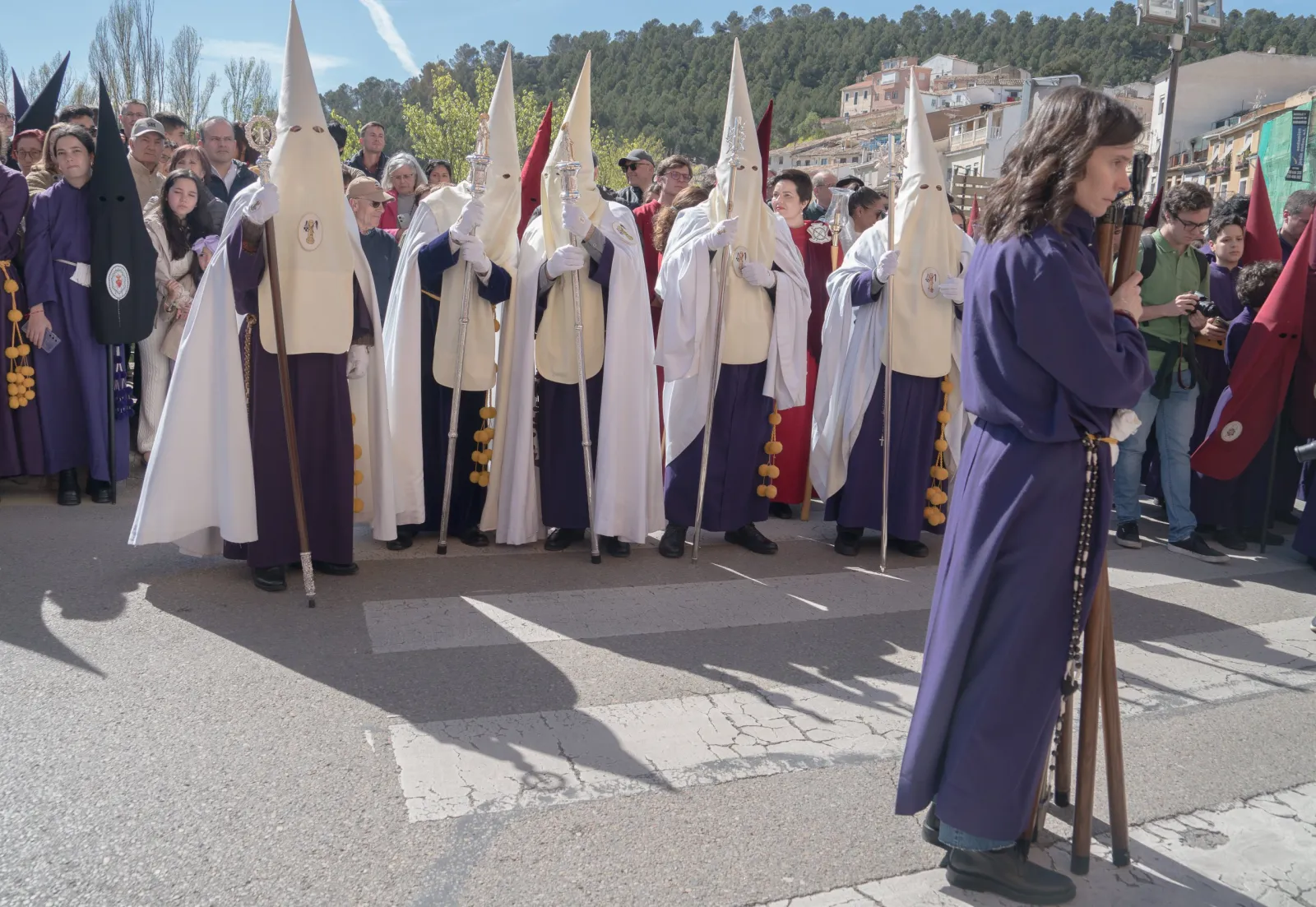
Good Friday has three moments. Before dawn comes Camino del Calvario, the procession of the Nazarenes from El Salvador, with the Turbas: rows of drums and bugles going ahead of the Nazareno de El Salvador and representing the mocking crowd. Later in the day En el Calvario follows the Crucifixion, and at night the Santo Entierro leaves the Cathedral and crosses a silent city. On Holy Saturday at seven in the evening, the Duelo leaves San Esteban for Plaza Mayor, and on Easter Sunday El Encuentro closes the week.
A stage made of slopes
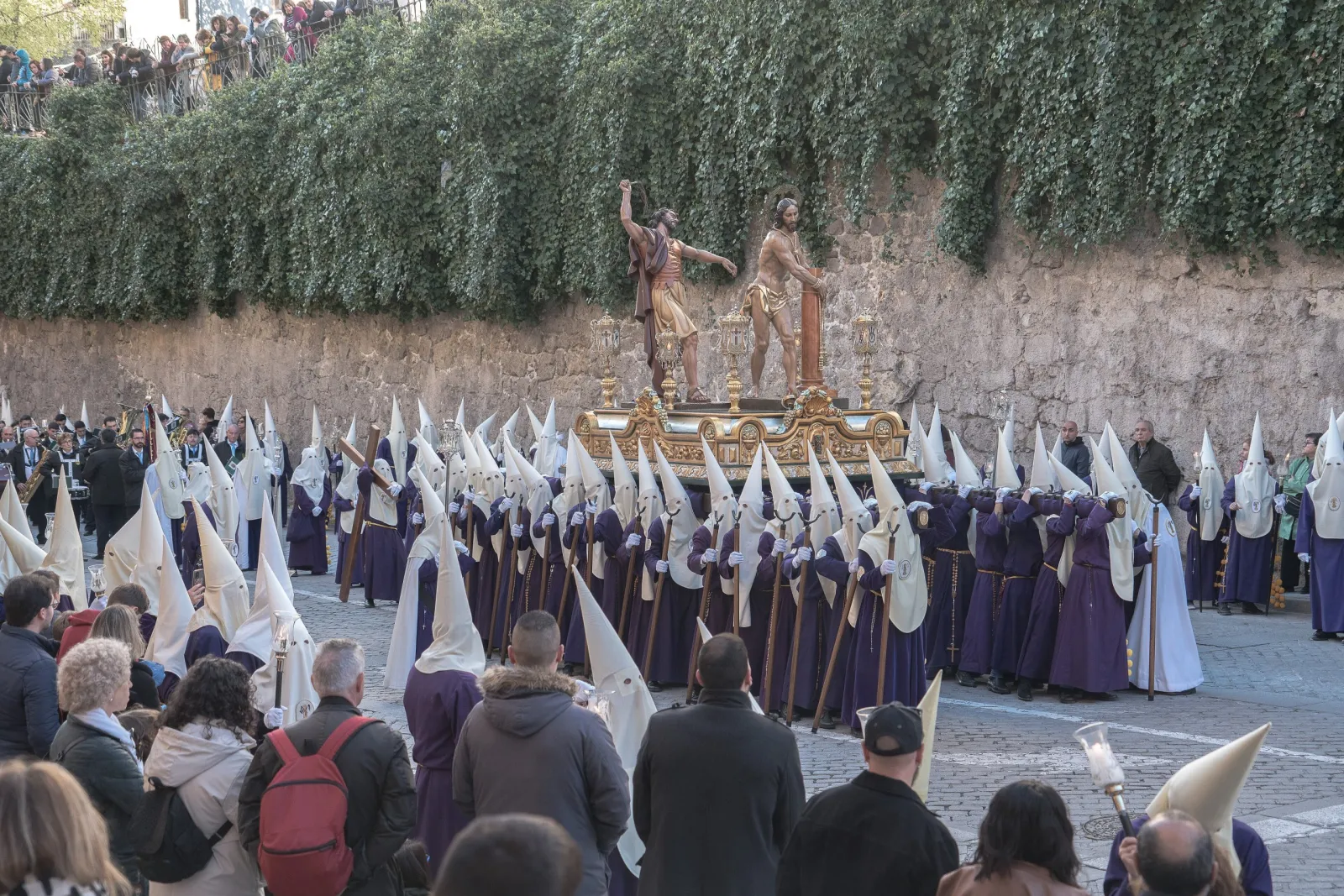
The setting is a big part of the experience: steep lanes between the hanging houses, the cathedral square and the curves of the climb from the river. Locals say that Calle del Peso sets the maximum width of a paso, so tight that from some windows you could almost touch the images, and that the arches of the town hall, which every procession passes on its way into Plaza Mayor, set their maximum height. From San Felipe Neri the Miserere is sung as the processions come down.
Most of the images are modern, because almost everything was destroyed in the Civil War. Many were carved in the 1940s and 1950s by Luis Marco Pérez, from Fuentelespino, whom the Junta calls the true sculptor of Cuenca's Holy Week. The one pre-war image still in the processions is the small 16th-century ivory Cristo de Marfil. Above all, Cuenca is known for its silence: the Junta reminds visitors that in Cuenca nobody applauds a paso.
Gallery
History & Origins
According to the Junta de Cofradías, Cuenca's Holy Week was born more than four centuries ago in the area of the old convent of San Francisco, where the church of San Esteban now stands, and the first dawn procession on Good Friday, then called "de los Nazarenos", is documented in 1616. The Turbas as we know them appeared in the 19th century, closely tied to the brotherhood of Nuestro Padre Jesús Nazareno de El Salvador: at the start of the 20th century they were just six bugles, six drums and a leader, all from humble families, and the mayor is said to have paid each one a real and a piece of alajú.
The Civil War destroyed almost all the old images, and the week had to be rebuilt from 1939. The Turbas were reorganised with twelve bugles and twelve drums, and the sculptor Luis Marco Pérez carved many of the new pasos, from the Nazareno de El Salvador (1941–1945) to the Cristo Yacente (1943) and the Jesús de Medinaceli (1951). New processions were added, such as El Perdón on Holy Tuesday in 1951, and newer brotherhoods have joined since, like the Vera Cruz with its 18th-century crucifix in 1985.
In 1962 the city also launched the Semana de Música Religiosa, a sacred-music festival held around Holy Week. Cuenca's Holy Week was declared of International Tourist Interest in 1980. Today the Junta de Cofradías asks participants to keep the Turbas true to their roots, with the Miserere heard in silence and no shouting or pushing.
What to Expect
Each day has its own procession and its own mood, so the week works best if you stay several days rather than just Holy Thursday night. The upper old town is steep and the lanes are narrow; the bearers (banceros) carry the pasos up and down slopes that test anyone, and the crowd follows on foot. Watch how the capataz steers each paso through the two bends of Calle del Peso with as few manoeuvres as possible.
The dawn procession on Good Friday is the loudest and most crowded moment, with the drums and bugles of the Turbas in the dark. The Junta de Cofradías stresses that it is a religious procession: the bugles sound when the Nazareno appears round a bend or sets off after a rest, the Miserere is heard in silence, and shouting, jumping or pushing are not part of the tradition. The rest of the week is the opposite: long, quiet processions where nobody claps and the only sounds are the band, the drum that sets the bearers' pace and, on Monday night, a choir.
Processions walk in the roadway and the route has reserved areas for people with reduced mobility, the press and the Junta's band; keep them clear, and never cut through a procession. If you have to cross, ask a nazareno carrying a staff and he will show you where. Nights in the Serranía in late March are cold.
How to Get There
Train: high-speed trains on the Madrid–Valencia line stop at Cuenca Fernando Zóbel station, on the edge of the city, under an hour from Madrid; take a city bus or taxi to the old town.
Car or bus: Cuenca is reached from Madrid by the A-3 and A-40. Buses run from Madrid and Valencia to the bus station in the lower town.
The upper old town has very limited parking and access is restricted during the processions; leave the car below and walk or take the bus up. Allow time: the climb from Carretería to Plaza Mayor is long and steep.
Tips & Advice
- Arrive by Friday of Sorrows or Palm Sunday and stay several nights to see the Passion unfold day by day.
- For Good Friday dawn, find your spot on the route well before the Turbas set off and keep a respectful distance.
- Do not clap at the pasos: in Cuenca silence is the rule.
- Space is limited in San Felipe Neri for the blessing of palms and in Plaza Mayor, and access may be closed when they fill up; the climb from the Trinidad bridge is a good alternative spot.
- Wear grippy shoes and warm layers for steep, cold night streets.
- Try the Lent dishes the Junta recommends: potaje de vigilia, torrijas, alajú and a glass of resolí.
- Check routes and times on the Junta de Cofradías website.
Photos: Nemo / CC BY-SA 4.0 / Wikimedia Commons; Pedro M. Martínez Corada / CC BY-SA 4.0 / Wikimedia Commons
Holy Week in Toledo
Toledo, Castilla-La ManchaToledo's Holy Week is known for its sobriety: some twenty brotherhoods carry their images through the narrow lanes of the UNESCO-listed old town, often late at night and in near silence.
Corpus Christi de Toledo
Toledo, Castilla-La ManchaToledo's Corpus Christi is Spain's most spectacular religious procession. Medieval streets are covered with awnings and aromatic herbs as the golden Custodia de Arfe — a 16th-century masterpiece standing 3 metres tall — processes through the ancient capital.
Feria de Albacete
Albacete, Castilla-La ManchaEleven days and nights of fair in honour of the Virgen de los Llanos, centred on Albacete's unique pan-shaped fairground and its famous iron gate.
Medieval Festival of Sigüenza
Sigüenza, Castilla-La ManchaThe Jornadas Medievales de Sigüenza transform this magnificent castle town into a living medieval spectacle every July. With jousting tournaments beneath the imposing castle-parador, a sprawling artisan market, theatrical battles, medieval banquets and hundreds of costumed participants, Sigüenza offers one of Spain's most authentic and atmospheric medieval experiences. Declared a Festival of Regional Tourist Interest.