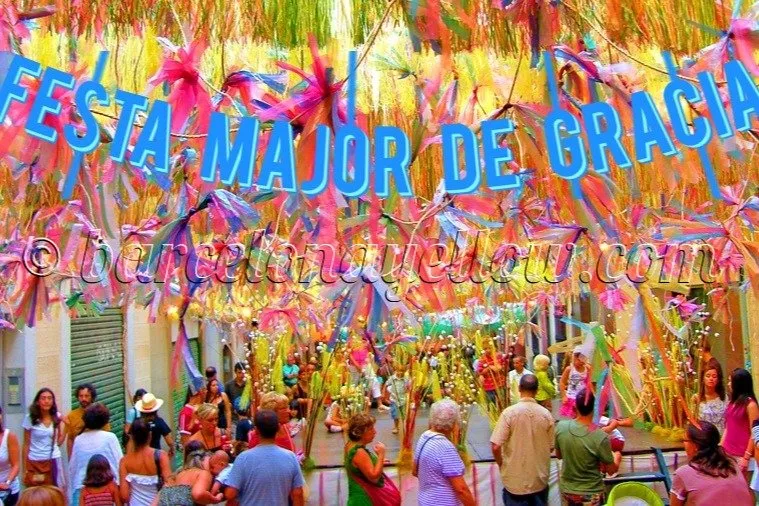
Festa Major de Gràcia
Each August, the Gràcia neighborhood erupts into a spectacular celebration where streets compete to create the most imaginative decorations from recycled materials, with live music and communal dinners.
Highlights
Streets compete each year to build the most imaginative decorated installations
Castellers, correfocs, gegants, and trabucaires fill ten days of festivities
Declared a Traditional Festival of National Interest by Catalonia in 1997
Rooted in a neighbourhood tradition dating back to the mid-1800s
Each August, the Gràcia neighbourhood of Barcelona spends a week transformed by one of Spain's most distinctive community traditions: residents of each street spend months beforehand building elaborate, large-scale decorations — entire ceilings and walls of recycled cardboard, plastic and paper turned into underwater scenes, space stations or fantastical worlds — and compete for the prize of best-decorated street. The custom traces to a procession held on 15 August 1817, when residents returned a statue of the Virgin Mary, hidden nearby during the Peninsular War, to the neighbourhood's Convent de Jesús; the celebration that followed became an annual fixture, and street decoration — documented from the late 19th century and run as a judged competition since the 1920s — became its defining feature. Beyond the decorated streets, the ten days bring live music on outdoor stages, castellers (human towers), correfocs (fire-runners), and communal meals set up directly in the street, with residents' associations, not the city council, organising almost everything.
History & Origins
The neighbourhood of Gracia grew up in the seventeenth century on the plain outside Barcelona, around the convent of Nuestra Senora de Gracia, popularly known as Josepets, from which the district takes its name. Gracia was legally part of Barcelona at first, became an independent town with its own council in 1850, and was finally annexed back into the city in 1897. The neighbourhood's main festival was originally held on May 15th, the feast of Saint Isidore, but in 1812, when the convent of Jesus roughly halfway between the city and Gracia was demolished, its resident monks relocated to the convent of Josepets and began holding a festival on August 15th, the feast of the Virgin of August. When Gracia gained its own municipal government in 1850, this became the neighbourhood's official festa major, celebrated around that date and running for a week to ten days ever since. Around this period Gracia was rapidly industrialising and its population was growing quickly, and it was in these years that the custom of decorating the streets began, likely as a secular counterpart to the greenery traditionally hung for Corpus Christi. By the early twentieth century the decorated streets had become genuine works of theatrical design, with well-known artists of the day contributing to the scenography, and a street-decoration competition and organising committee, the forerunner of today's festival federation, were established by the mid-1930s. During the Franco dictatorship the festival often carried an undercurrent of protest, with sardana dances and concerts serving as rare public expressions of Catalan culture. Popularity dipped in the 1970s, but the tradition recovered strongly in later decades, and in 1997 the Catalan government declared it a Traditional Festival of National Interest.
What to Expect
The festival's signature feature is the transformation of dozens of streets into elaborate, hand-built installations, with residents' associations competing each year to produce the most imaginative decorated street, often using recycled materials to build entire immersive scenes overhead and along the facades. Alongside the decorated streets, the programme includes concerts and open-air dances, castellers building human towers, gegants and capgrossos giants and big-heads parades, correfocs with fire-breathing devils and dragons running through the crowds, processions of bastoners stick-dancers and trabucaires musket-firing bands, and a religious mass honouring Our Lady of Gracia. The festival typically runs for around ten days from August 15th, filling the compact streets of the Gracia district with an atmosphere that feels distinct from Barcelona's larger, more tourist-oriented events.
How to Get There
Gracia is a central Barcelona neighbourhood just north of the Eixample district, easily reached from anywhere in the city by metro, with several stations including Fontana, Diagonal, and Joanic serving the area directly. Barcelona's El Prat airport connects the city to major hubs across Europe and beyond, and the city's main train stations, Sants and Barcelona-Franca, link Gracia to the rest of Spain by rail. Once in the neighbourhood, the decorated streets and festival activities are concentrated in a compact area that is best explored entirely on foot.
Tips & Advice
The decorated streets draw enormous crowds, especially in the evenings and at weekends, so visiting on a weekday afternoon offers a calmer look at the installations before the festivities intensify. Many of the best-known streets publish their unveiling dates in advance, so check the programme if you want to see a particular design freshly completed. Correfoc fire-runs involve real sparks and flames at close range, so if you want to watch, keep a safe distance and consider covering exposed skin and hair; participating directly requires appropriate protective clothing. Since the festival takes place in mid-August, expect hot weather and plan for shade and water during the day, saving energy for the lively evening events.
Plan Your Trip
Book accommodation and transport for this festival. Get the best deals on hotels and train tickets.
This page contains affiliate links. We may earn a commission at no extra cost to you.
Fires de Sant Narcís
Ten days honouring Girona's patron saint with castells competitions, correfoc fireworks, sardana dancing, fairground rides, and concerts.
 May
May
La Patum de Berga
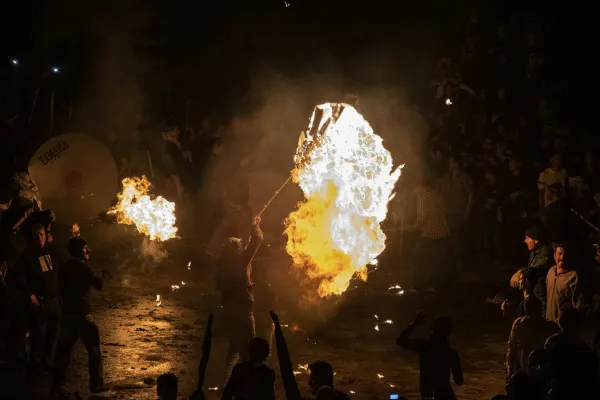
La Patum is a medieval festival of fire, music and mythical beasts celebrated in the mountain town of Berga during Corpus Christi week. Recognised by UNESCO as a Masterpiece of the Oral and Intangible Heritage of Humanity in 2005, it features fire-breathing demons, battling angels, giants and a climactic inferno called the Salt de Plens where the entire plaza erupts in flames. It is one of the oldest and most intense festival traditions in Spain.
 December
Fira de Santa Llúcia
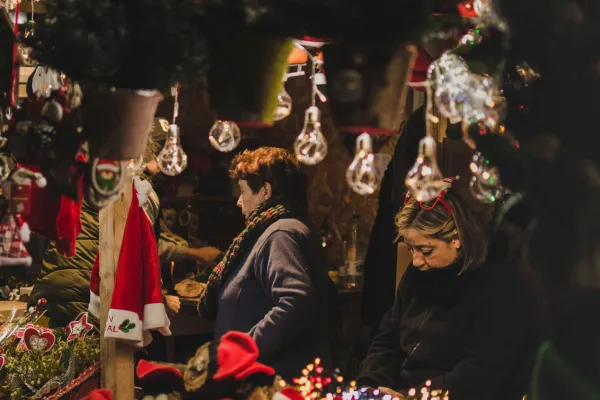
Barcelona's oldest Christmas market (since 1786) fills the square in front of the Cathedral with nativity scene figures, caganers, Christmas trees and traditional Catalan holiday crafts.
 November
Todos los Santos & Castañada
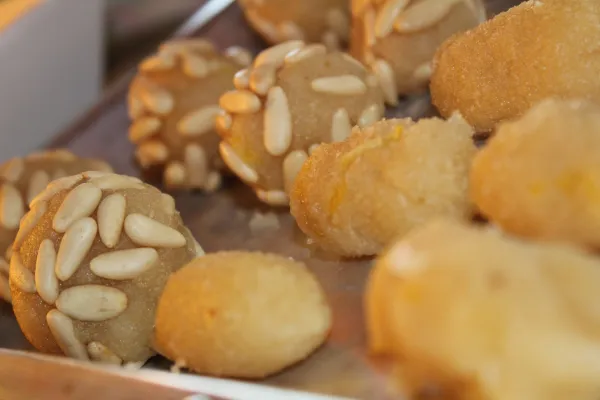
Barcelona's official 2026 programme spreads Castañada and All Saints activities across the districts, from chestnut celebrations and panellet workshops to a Poblenou Cemetery night route and an Old Town correfoc.