Holy Week in Cáceres
Processions winding through one of Europe's best-preserved old towns, from the silent midnight walk of the Cristo Negro to the joyful Encuentro in Plaza Mayor on Easter Sunday.
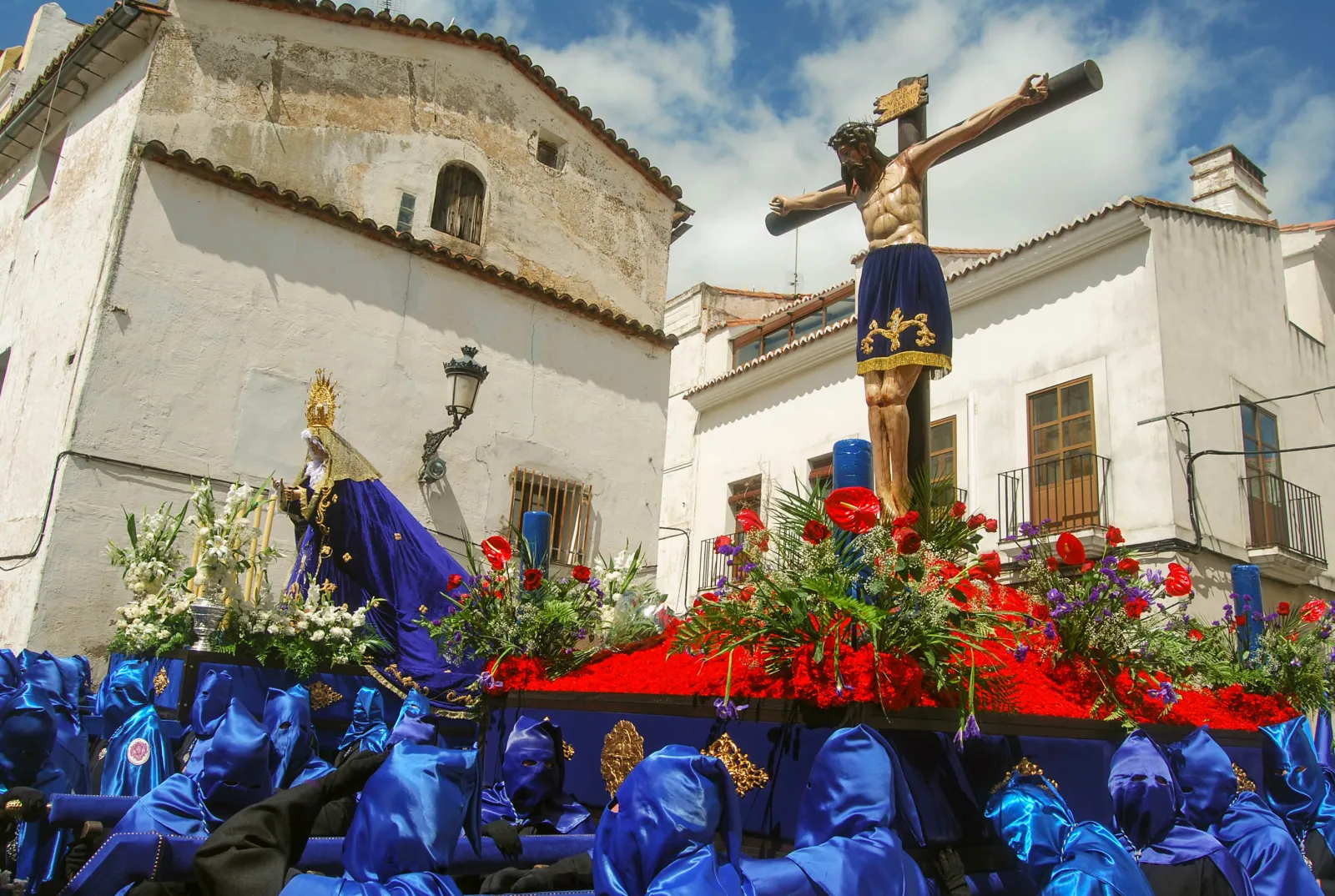
The days that matter
-
Sun 21 Mar midday
Palm Sunday: La Burrina
Blessing of palms in Plaza de San Juan and the procession of Jesus on the donkey.
-
Wed 24–Thu 25 Mar midnight
Cristo Negro
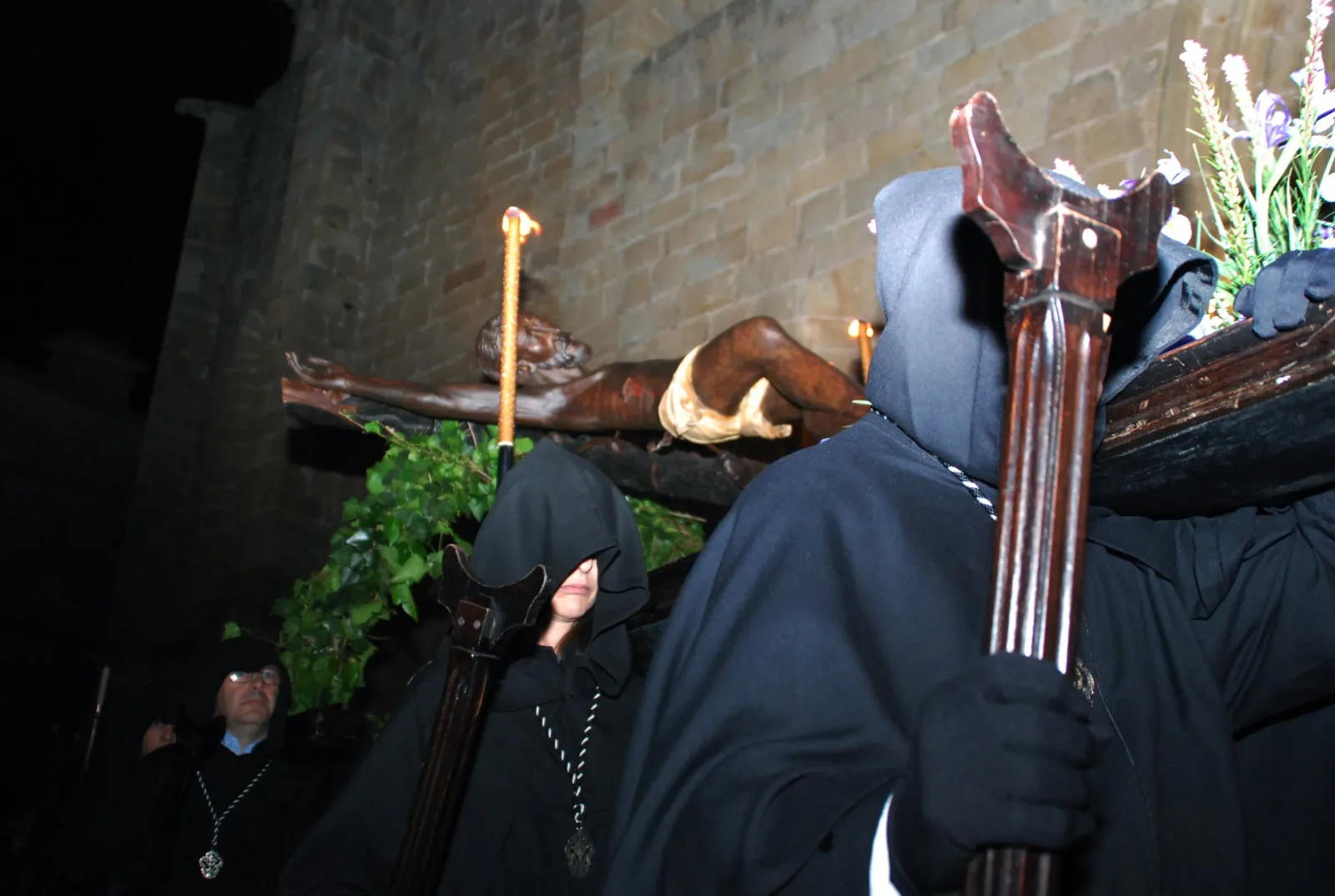
The 14th-century crucifix leaves the Concatedral de Santa María and walks the old town in total silence.
-
Thu 25 Mar night
Procesión del Amor
The procession stops in Plaza de San Juan to stage the scene of Christ entrusting his mother to John.
-
Fri 26 Mar before dawn
Madrugada of Jesús Nazareno
The oldest brotherhood carries the Nazarene out of the church of Santiago before dawn.
-
Fri 26 Mar evening
Descendimiento and Santo Entierro
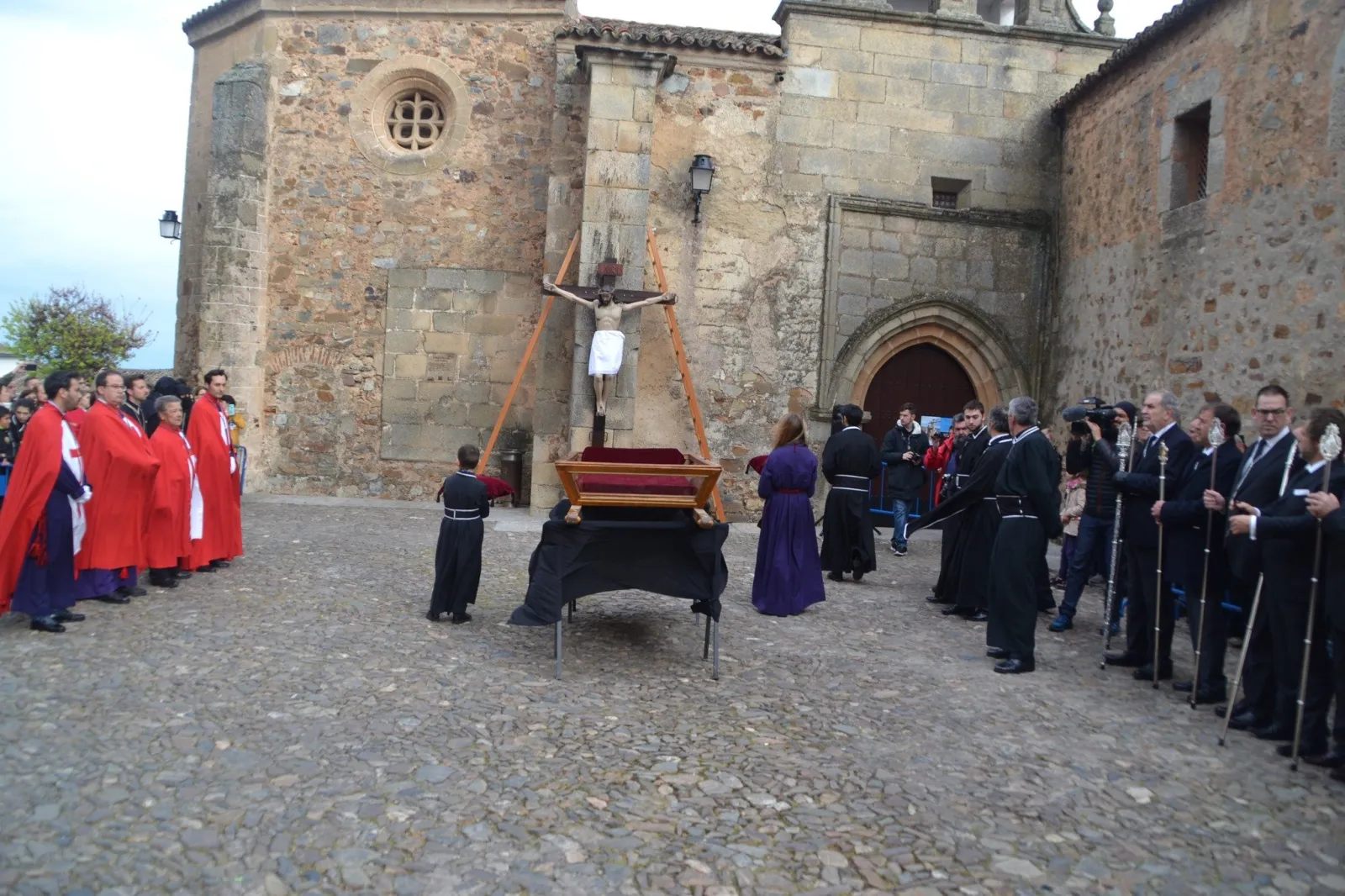
Christ is taken down from the cross in Plaza de San Pablo, followed by the official Holy Burial procession.
-
Sun 28 Mar around midday
Encuentro
The risen Christ meets the Virgen de la Alegría in Plaza Mayor amid bells and petals.
What Holy Week in Cáceres is like
- Procession
- Night
- Noise
- Bands and drums, with long silences; the Cristo Negro is totally silent
- Crowds
- Narrow old-town lanes fill fast on Thursday and Friday nights
- Mess
- Clean; mind candle wax and slippery cobbles
- With kids
- Palm Sunday and Easter morning suit children; midnight walks less so
Highlights
Processions through the walled, UNESCO-listed Ciudad Monumental and along the adarves
The Cristo Negro at midnight between Holy Wednesday and Thursday, in total silence
The Cristo del Amparo on Holy Tuesday night, to the beat of a muffled drum
The pre-dawn Madrugada of Jesús Nazareno on Good Friday
The Descent from the Cross in Plaza de San Pablo
La Burrina and the blessing of palms on Palm Sunday
The Encuentro in Plaza Mayor on Easter Sunday
Holy Week in Cáceres 2027: 21–28 March
Holy Week in Cáceres runs from Palm Sunday, 21 March 2027, to Easter Sunday, 28 March 2027, with acts on Viernes de Dolores and the Saturday before that stretch it to ten days. The Unión de Cofradías Penitenciales coordinates the official guide, published by the Ayuntamiento shortly before Holy Week with the times and routes of every procession.
A stage like no other
What sets Cáceres apart is the setting. Most processions start in or cross the walled Ciudad Monumental, a UNESCO World Heritage old town of stone palaces, towers, narrow lanes and steep slopes. Seeing a paso lit by candles pass under the arches and along the adarves, the lanes that run along the inside of the walls, is the reason people come. The mood is sober and devout, with brass bands, the occasional saeta sung to an image, and long stretches of silence.
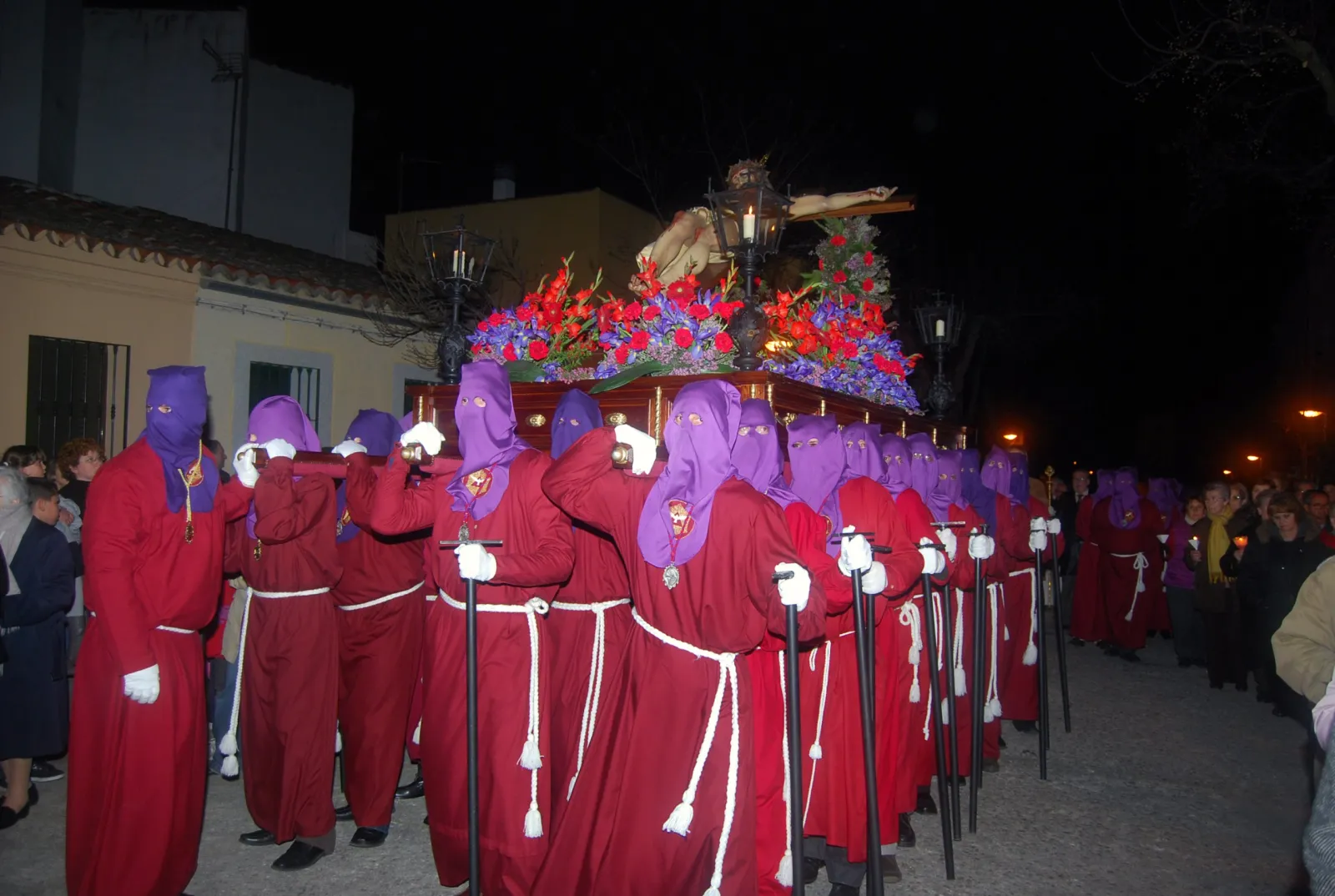
Seventeen brotherhoods take part, some dating back to the 15th century, and most carry their pasos on their shoulders in the Castilian way; since the mid-2000s a few have adopted the Andalusian costalero style. The single most famous moment is the Cristo Negro: at midnight between Holy Wednesday and Holy Thursday, a dark 14th-century crucifix leaves the Concatedral de Santa María and walks the old town in complete silence, lit only by candles, escorted by brothers in Benedictine habits with esparto cords. The only sounds are a handbell and a muffled drum, as the cortege climbs the Adarve de la Estrella, passes the squares of San Mateo, San Pablo and San Jorge and returns to Santa María at around half past two.
The rest of the week
On Palm Sunday La Burrina leaves San Juan, with the blessing of palms in Plaza de San Juan. On Holy Tuesday night the Cristo del Amparo, a Castilian-school Nazarene from 1669, walks from its hermitage to San Mateo to the beat of a muffled drum. On Holy Thursday morning the Sagrada Cena, a Last Supper group by the Sevillian sculptor Antonio Dubé de Luque, leaves the church of Santiago, and that night the Procesión del Amor stages the Gospel scene of Christ entrusting his mother to John in Plaza de San Juan.
Good Friday is the fullest day. At 5:00 the oldest brotherhood carries Jesús Nazareno, carved by Tomás de la Huerta in 1609, out of the church of Santiago for the Madrugada, its brothers in purple tunics and white capes with the cross of Santiago. At 15:00 the Expiración pauses in Plaza de San Mateo, and in the evening the Descent from the Cross is enacted in Plaza de San Pablo before the Santo Entierro leaves the hermitage of La Soledad. On Easter Sunday the risen Christ, from San Mateo, and the Virgen de la Alegría, from La Soledad, meet in the middle of Plaza Mayor, at the steps of the Arco de la Estrella. Cáceres' Holy Week was declared a Fiesta de Interés Turístico Internacional in 2011.
Gallery
History & Origins
Holy Week has deep roots in Cáceres: the regional tourism board notes references to its celebration from the 16th century, and some brotherhoods go back to the 15th. The Cofradía de Nuestro Padre Jesús Nazareno, which processes in the Good Friday Madrugada with an image carved by Tomás de la Huerta in 1609, is considered the oldest, and the Cristo Negro, a crucifix dated to the 14th century, gives the week its most medieval moment. The 20th century brought new brotherhoods, starting with the Cofradía de los Ramos in 1946, and others such as the Estudiantes in 1958.
The celebrations declined during the political transition of the late 1970s and revived from 1982. In 1986 the brotherhoods formed the Unión de Cofradías Penitenciales and recovered the official pregón; today the Unión groups seventeen brotherhoods and coordinates the official guide each year. From the mid-2000s new brotherhoods brought the Andalusian costalero style to a city of shoulder-borne pasos, and newer images joined the week, such as Dubé de Luque's Sagrada Cena, completed between 1995 and 2009. In April 2011 Spain's General Secretariat for Tourism declared Cáceres' Holy Week a Fiesta de Interés Turístico Internacional, and the city is one of the fifteen members of the Spanish association of Holy Week in World Heritage Cities.
What to Expect
Cáceres is compact, and the old town is small enough to follow a procession on foot, cut through a side lane and catch it again further on. The routes climb and drop over cobbles, along the adarves (wall-top lanes) and through squares such as Santa María, San Mateo, San Jorge and the Plaza Mayor, so wear comfortable shoes.
The Cristo Negro night is the most intense. The brotherhood asks for silence along the whole route, and the old town goes dark except for candles; find a spot near the Concatedral or on the adarves well before midnight and keep your phone torch off. On Holy Thursday the Procesión del Amor stops in Plaza de San Juan to stage the Gospel scene in which Christ entrusts his mother to John.
Good Friday is the fullest day: Jesús Nazareno leaves the church of Santiago before dawn for the Madrugada, the Expiración procession pauses in Plaza de San Mateo in the afternoon, and in the evening the Descent from the Cross is enacted in Plaza de San Pablo before the official Santo Entierro. On Easter Sunday the mood changes completely, with bells, petals and applause as the risen Christ meets the Virgin in Plaza Mayor.
To understand the pasos and brotherhoods, visit the Holy Week interpretation centre in the Iglesia de la Preciosa Sangre.
How to Get There
Cáceres is in Extremadura, in western Spain.
- By train: Cáceres station has direct Renfe services from Madrid and connections with Badajoz and the rest of Extremadura. From the station, take a bus or taxi to the old town.
- By bus: long-distance coaches link Cáceres with Madrid, Seville and Salamanca.
- By air: Madrid-Barajas is the main international gateway; Badajoz airport has a handful of domestic routes.
- By car: the A-66 Ruta de la Plata motorway passes Cáceres on its way between Seville and Salamanca, and the A-58 links it with the A-5 from Madrid at Trujillo. The old town is closed to traffic, so park outside the walls and walk up from Plaza Mayor.
Tips & Advice
- Get the official Holy Week guide from the Unión de Cofradías or the tourist office for 2027 times and routes; times can change with the weather.
- For the Cristo Negro, be in place well before midnight and respect the silence: no talking, no flash, no torches.
- If you can only manage one early start, make it the Madrugada: Jesús Nazareno leaves Santiago at 5:00 and walks the adarves at first light.
- Wear shoes with grip for the steep cobbled lanes, and bring a warm layer for the late nights.
- Use the old town's side lanes to see a procession twice: let it pass, cut ahead and wait at another corner.
- Book accommodation early, especially inside or near the walls, for Holy Thursday and Good Friday nights.
Photos: Sergio C. / Public Domain / Wikimedia Commons; Fernando Montes Macías / CC BY 4.0 / Wikimedia Commons
Cherry Blossom in the Jerte Valley
Valle del Jerte, ExtremaduraEvery spring the terraced slopes of the Jerte Valley in northern Extremadura turn white with more than a million and a half cherry trees in flower, and its eleven villages throw a festival to match.
Carnaval de Badajoz
Badajoz, ExtremaduraThe Carnaval de Badajoz is mainland Spain's largest carnival celebration, with over 100,000 people parading through the streets in spectacular comparsas and murgas. Declared a Fiesta of International Tourist Interest, it rivals the Canary Islands carnivals in scale and creativity.
WOMAD Cáceres
Cáceres, ExtremaduraWorld of Music, Arts and Dance transforms the UNESCO medieval old town into a global music stage. Free concerts and workshops by artists from Africa, Asia, and Latin America.
Jarramplas (Piornal)
Plasencia, ExtremaduraJarramplas is a traditional winter festival in Piornal (Extremadura), typically around 19–20 January, where a masked character is pelted with turnips in a ritual tied to local identity and devotion to San Sebastián.