Drum Route of Lower Aragon (Ruta del Tambor y el Bombo)
Over Easter, nine towns in Lower Aragon drum almost without pause, from the midnight Romper la Hora in Híjar to the noon one in Calanda: a UNESCO-listed wall of sound.
The days that matter
-
Thu 25 Mar midnight
Romper la Hora in Híjar
At midnight the drums break out in Plaza de la Villa and keep going until Saturday afternoon.
-
Thu 25 Mar night
Via Crucis in Calanda
Drummers take part in the night Via Crucis, carrying Christ up the slopes of the Calvary.
-
Fri 26 Mar 12:00
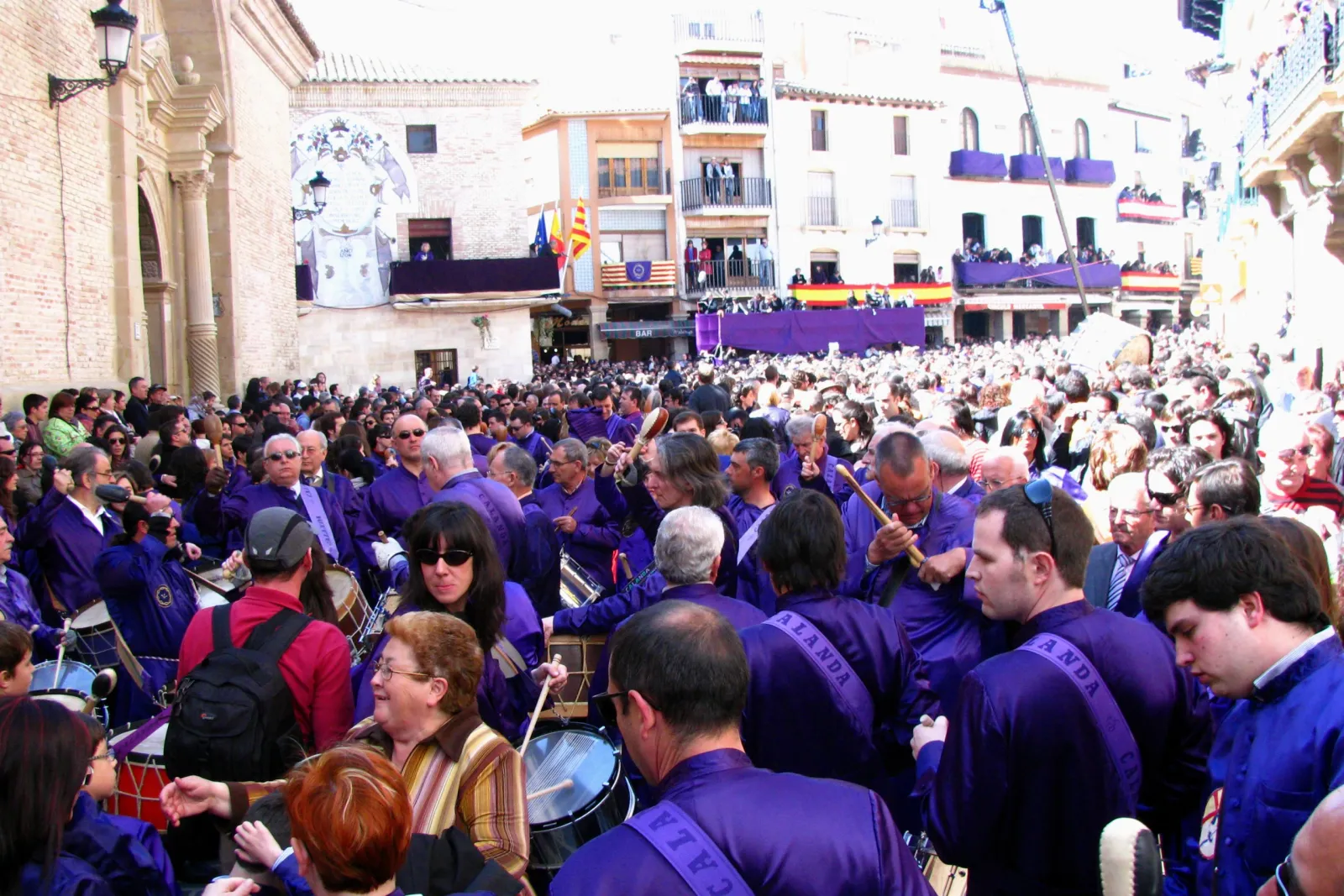
Romper la Hora in Calanda
The only midday Rompida on the Ruta: thousands of purple-clad drummers start at once.
-
Fri 26 Mar afternoon and dusk
El Pregón and La Soledad
Calanda's afternoon and dusk processions, with the herald, barefoot penitents and the Putuntunes.
-
Sat 27 Mar until 14:00
El Entierro and the end of the drums
After the sealing of the tomb in Plaza de España, Calanda's drums play the Marcha Palillera and stop at 14:00.
What Drum Route of Lower Aragon (Ruta del Tambor y el Bombo) is like
- Loud
- Procession
- Night
- Free
- Noise
- Thousands of drums for hours on end; bring ear protection
- Crowds
- Squares packed tight for Romper la Hora
- Mess
- You stay clean; sleep is the casualty
- With kids
- Local kids drum too, but small ears need defenders
Highlights
- Romper la Hora in Híjar at midnight on Holy Thursday
- Romper la Hora in Calanda at noon on Good Friday, unique on the Ruta
- Andorra's drummers climbing to the hermitage of San Macario before dawn on Good Friday
- Calanda's El Pregón and La Soledad processions, with the Roman guard of the Putuntunes led by Longinos
- Alcorisa's Drama de la Cruz on the Monte Calvario
- Alcañiz's Procesión del Silencio after the Holy Thursday service
- Tunics in blue, purple or black depending on the town
Ruta del Tambor y el Bombo 2027: dates
The drums of Lower Aragon sound throughout Holy Week, but the core days are Holy Thursday 25 to Holy Saturday 27 March 2027. In Híjar and most other towns the drumming bursts out at midnight on Thursday; in Calanda it starts at noon on Good Friday; the drums fall silent on Saturday, at 14:00 in Calanda and at 22:00 in La Puebla de Híjar. Each town publishes its own programme on rutadeltamborybombo.com.
Nine towns, one deafening tradition
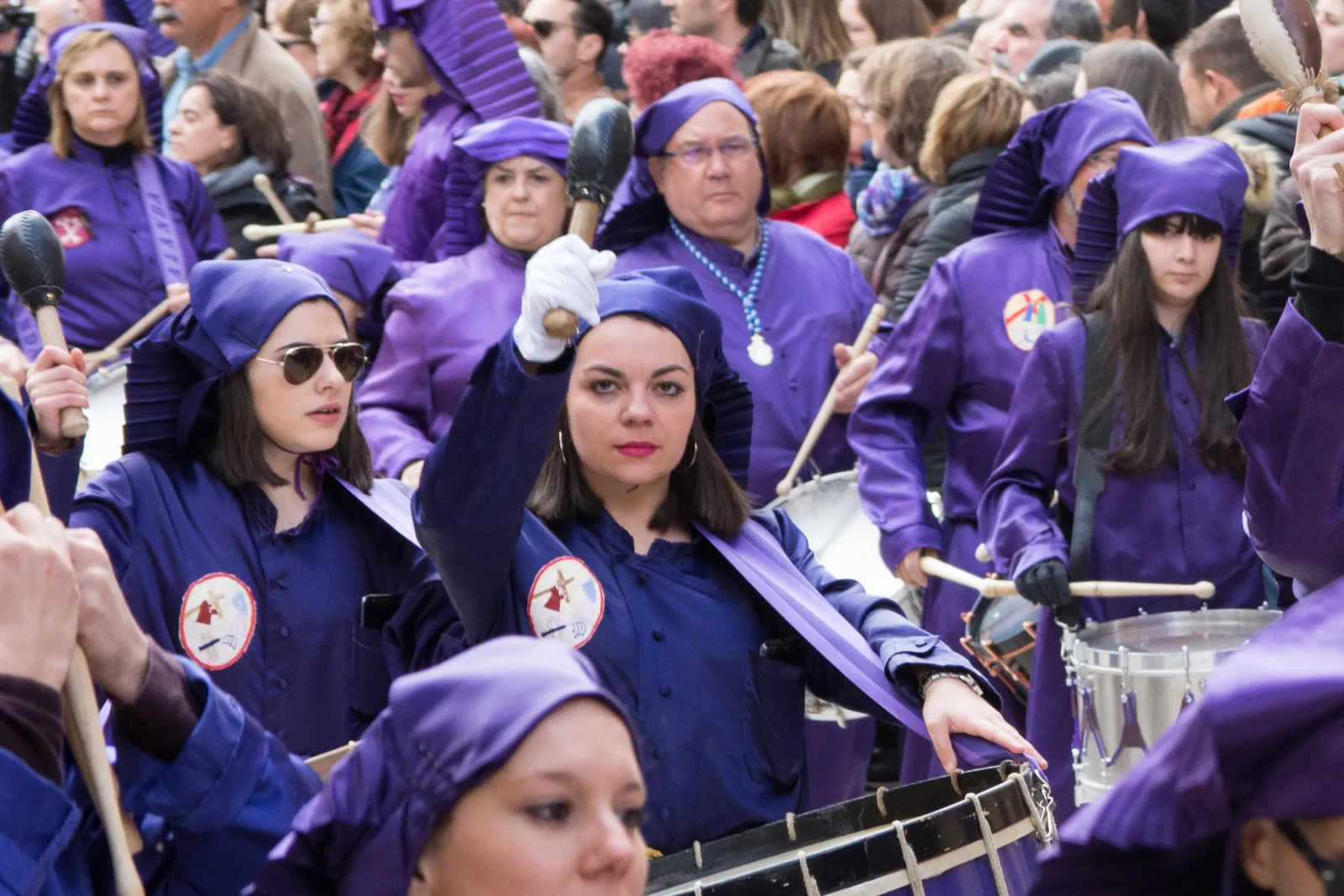
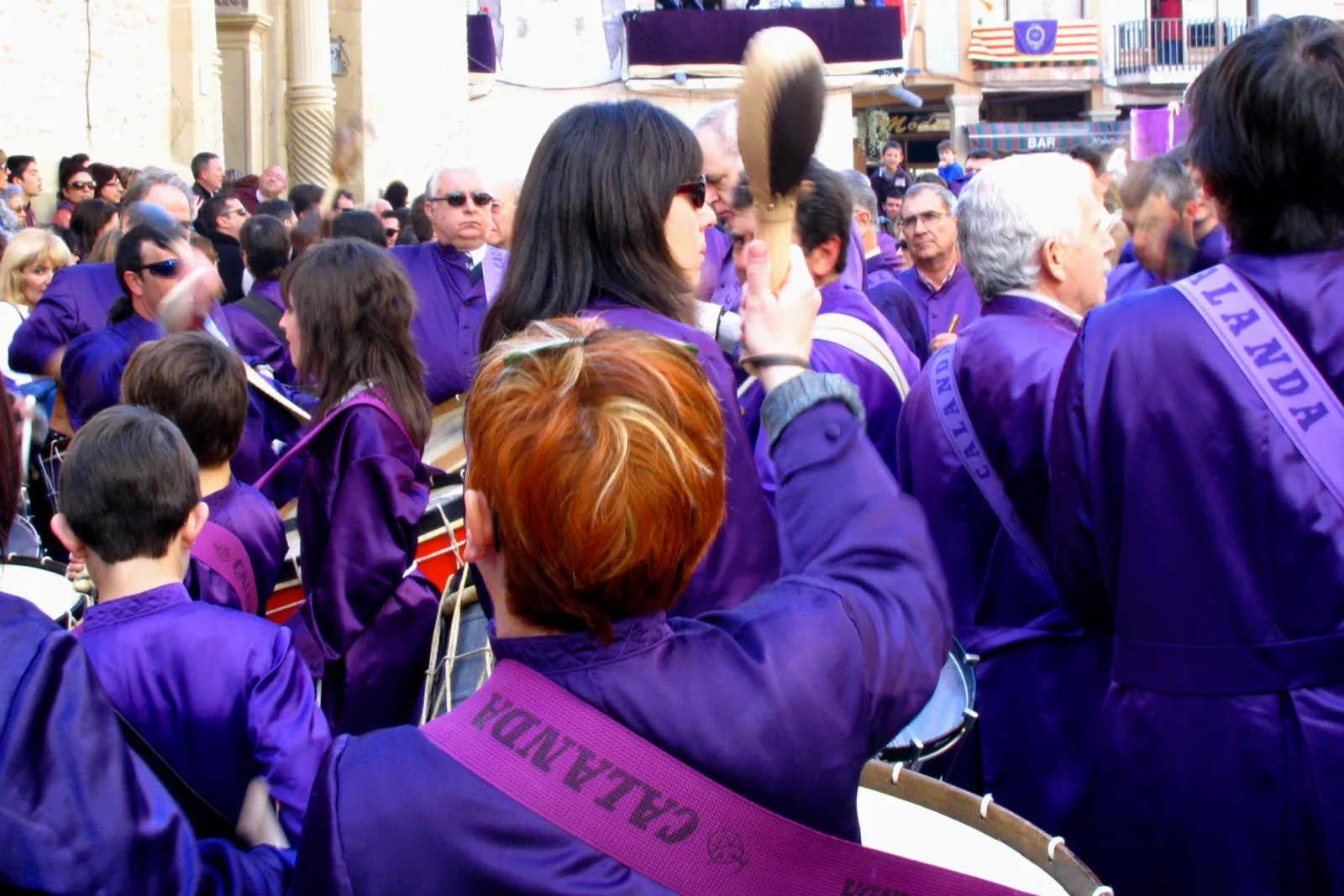
The Ruta del Tambor y el Bombo links Albalate del Arzobispo, Alcañiz, Alcorisa, Andorra, Calanda, Híjar, La Puebla de Híjar, Samper de Calanda and Urrea de Gaén, all in the province of Teruel. In each, hundreds of locals in long tunics and the tercerol, a hood that falls in folds down to the feet, accompany the Holy Week services with drums and bass drums. The tunic colour tells you where you are: blue in Alcañiz, purple in Calanda and Alcorisa, black in the other towns.
The defining moment is Romper la Hora, "breaking the hour": a packed square waits in silence until, at a signal, thousands of drums start at once. In Híjar it happens in Plaza de la Villa on the stroke of midnight on Holy Thursday, and the drums keep going until Saturday afternoon. Calanda, Luis Buñuel's birthplace, is the only town that breaks the hour at midday on Good Friday, after a Thursday-night Via Crucis up to the Calvary.
Each town its own way
The ritual is shared, but every town adds its own details. In Andorra the hour breaks in Plaza del Regallo, the drummers wear black tunics with a red sash, and before dawn on Good Friday long lines of drums climb to the hermitage of San Macario to pray by torchlight. In La Puebla de Híjar tradition says the midnight drumming is done without tunics, which go on at daybreak. In Samper de Calanda a bugle from the town hall balcony gives the signal, and on Good Friday afternoon the Abajamiento with the Cristo de la Cama re-enacts the death of Christ. Urrea de Gaén, a village of about 600 people, puts some 350 drums and 180 bass drums on the street, its drummers marked out by a white neckerchief. Alcorisa stages the Drama de la Cruz, an open-air Passion play on its Monte Calvario that began in 1978 and involves more than 300 actors; Albalate del Arzobispo is known for its Good Friday morning Via Crucis, and Alcañiz for the Procesión del Silencio after the Holy Thursday service at Santa María.
The Ruta has been a Festival of International Tourist Interest since 2014, and on 29 November 2018 UNESCO inscribed "Tamboradas, drum-playing rituals" on its Representative List of the Intangible Cultural Heritage of Humanity. The organisers stress that, behind the explosion of sound, it remains a religious tradition built on respect for faith and personal freedom of belief.
Gallery
History & Origins
The roots go back to medieval religious practice. In 1519 the Duke of Híjar asked the Franciscans to organise Holy Week formally, the first solid record of a processional structure that would later include drums and bass drums, and in 1595 Calanda blessed its first Calvary. During the 19th and 20th centuries brotherhoods multiplied and each town defined its own style of playing; after the war the big bass drum spread and the sound became the massive, coordinated roar heard today. Alcañiz put up its Monumento al Tambor, an iron figure of a drummer by the Teruel sculptor José Gonzalvo, in 1968.
On 5 September 1970 the towns founded the association of the Ruta del Tambor y Bombo to protect and promote the tradition together, and since 1976 its Jornadas de Convivencia have brought the drum groups of all nine towns together each year, in a different town each time, as a prelude to Holy Week. Its drummers played at the opening of the Barcelona 1992 Olympics and at Expo '92 in Seville. Several towns were declared of National Tourist Interest in 2005, the Ruta became International in 2014, UNESCO recognised the tamboradas in 2018, and that same year the Ruta opened its museum and headquarters in Híjar.
What to Expect
Noise you feel in your chest. Once the hour is broken, drummers of every age play in the streets for hours on end, by day and night, so sleep is a challenge and ear protection is a good idea, especially for children. Whole families drum together, in groups called cuadrillas, and visitors are welcome to watch and follow them through the streets. The Ruta itself describes the sound as something you feel rather than just hear: the rhythm changes from town to town, and the drummers switch from one march to the next without breaking off.
Calanda's programme gives a good idea of the rhythm: on Good Friday afternoon El Pregón procession, with the herald proclaiming Christ's death; at dusk La Soledad, with biblical characters, barefoot penitents and the Putuntunes, a Roman guard led by Longinos; on Holy Saturday El Entierro and the Auto Sacramental del Sellado del Sepulcro in Plaza de España, after which the drums fall quiet in memory of Mosén Vicente Allanegui and the town's dead, then play the Marcha Palillera until exactly two o'clock, when they fall silent until next year.
Outside the big moments, the processions themselves are religious acts with pasos, brotherhoods and, in several towns, halberdiers or Roman soldiers, so keep a respectful distance and do not walk through the lines of drummers.
How to Get There
Train: La Puebla de Híjar station, on the Zaragoza–Caspe line, is the rail gateway to the Ruta; from there you need a car or taxi for the other towns.
Car: the nine towns lie within a short drive of each other in Lower Aragon, roughly between Zaragoza and Teruel; Alcañiz is the largest town and the usual base. A car lets you combine Híjar at midnight on Thursday with Calanda at noon on Friday. Expect closed streets and full car parks in the town centres around Romper la Hora, so park on the outskirts and walk in.
Bus: regional buses connect Alcañiz with Zaragoza, but services are limited on holidays.
Year-round: if you are in the area outside Holy Week, the Ruta's museum in Híjar, on the second floor of the Comarca del Bajo Martín building, explains the tradition; visits are by appointment.
Tips & Advice
- Bring earplugs or ear defenders, especially for children.
- Be in the square well before Romper la Hora: Plaza de la Villa in Híjar before midnight on Thursday, Plaza de España in Calanda before noon on Friday.
- If you stay up for Thursday midnight, rest in the morning: the drums do not stop, and Calanda's big moment is at noon.
- Book a room early in Alcañiz or the smaller towns; beds are scarce on Easter weekend.
- Download each town's programme from the Ruta's website.
- Do not touch or play someone else's drum without being invited.
Photos: Rubén Vique / CC BY 2.0 / Wikimedia Commons; Agustí Amorós Joseph / CC BY-SA 4.0 / Wikimedia Commons
Fiestas del Pilar
Zaragoza, AragónThe Fiestas del Pilar are Zaragoza's most important annual festival, celebrating the patron saint of the city — and of Spain itself — the Virgen del Pilar, on 12 October. The celebration lasts over a week and is one of Spain's largest October festivals, drawing hundreds of thousands of visitors.
The Weddings of Isabel de Segura (Lovers of Teruel)
Teruel, AragónEvery February the whole of Teruel dresses in 13th-century clothes to re-enact, almost in real time, the tragic love story of Isabel de Segura and Diego de Marcilla, the Lovers of Teruel.
Medieval Fair of Daroca
Daroca, AragónThe Feria Medieval de Daroca brings one of Aragon's most impressive walled towns back to its medieval heyday. Every July, Daroca's 4 km of walls, towers and Moorish gates frame a spectacular medieval market, theatrical reenactments, torchlit processions and artisan workshops. With its authentic architecture and passionate local participation, Daroca offers a medieval experience that feels genuinely lived-in rather than staged.
Semana Santa
Seville, AndalusiaSemana Santa (Holy Week) is arguably Spain's most emotionally powerful and visually stunning festival. In the week leading up to Easter Sunday, cities and towns across the country fill with solemn religious processions, haunting music, clouds of incense, and enormous ornate floats (pasos) carried by hundreds of robed nazarenos.